Total Pageviews

Thursday, 12 February 2009

NEWSFLASH:


NEWSFLASH


NEWSALERT: Wednesday, February 11, 2009 @ 2119 GMT
---------------------------------------------------------------------
The latest news from Spaceflight Now


TWO SATELLITES COLLIDE IN ORBIT
-------------------------------
In an unprecedented space collision, a commercial Iridium communications
satellite and a presumably defunct Russian Cosmos satellite ran into each
other Tuesday above northern Siberia, creating a cloud of wreckage,
officials said today.

http://spaceflightnow.com/news/n0902/11iridium/

Two Russian satellites launched together / Fireworks from a flaring star

     NEWSALERT: Wednesday, February 11, 2009 @ 1441 GMT
---------------------------------------------------------------------
         The latest news from Spaceflight Now


+++
ON SALE NOW - STS-119 the next shuttle mission patch
http://www.spaceflightnowstore.com
+++


TWO RUSSIAN COMMUNICATIONS SATELLITES SHARE RIDE TO SPACE
---------------------------------------------------------
A Proton rocket blasted off from a snow-covered launch pad early Wednesday
and successfully put a pair of Russian civil communications satellites
22,300 miles above Earth.

 http://spaceflightnow.com/news/n0902/11express/


SWIFT, FERMI PROBE FIREWORKS FROM FLARING GAMMA-RAY STAR
--------------------------------------------------------
Astronomers using NASA's Swift satellite and Fermi Gamma-ray Space
Telescope are seeing frequent blasts from a stellar remnant 30,000
light-years away. The high-energy fireworks arise from a rare type of
neutron star known as a soft-gamma-ray repeater. Such objects
unpredictably send out a series of X-ray and gamma-ray flares.

 http://spaceflightnow.com/news/n0902/10gammarays/


THREE EUROPEAN SPACE MISSIONS EXTENDED
--------------------------------------
The European Space Agency's Science Programme Committee has extended the
operations of the Mars Express orbiter, Venus Express orbiter and Earth
magnetosphere mission called Cluster.

 http://spaceflightnow.com/news/n0902/10esaextensions/

Resupply ship launches toward rendezvous with station

     NEWSALERT: Tuesday, February 10, 2009 @ 0909 GMT
---------------------------------------------------------------------
         The latest news from Spaceflight Now


+++
ON SALE NOW - The next shuttle mission embroidered patch
http://www.spaceflightnowstore.com
+++


RESUPPLY SHIP SET FOR FRIDAY RENDEZVOUS WITH STATION
----------------------------------------------------
A three-day orbital chase by a robotic cargo freighter to catch the
international space station began high above Earth early this morning with
the successful launch of the Russian-made resupply ship.

 http://spaceflightnow.com/news/n0902/10progress/


NASA AWARDS NUSTAR LAUNCH TO ORBITAL SCIENCES
---------------------------------------------
NASA has selected Orbital Sciences to launch the Nuclear Spectroscopic
Telescope Array, or NuSTAR, high energy X-ray telescope. The spacecraft
will fly in 2011 aboard a Pegasus XL rocket from the Pacific Ocean's
Kwajalein Atoll.


 http://spaceflightnow.com/news/n0902/09nustar/


MAJOR TEST OF SECOND AEHF SATELLITE UNDERWAY
--------------------------------------------
Lockheed Martin announced Monday that the second Advanced Extremely High
Frequency military communications satellite is now undergoing thermal
vacuum testing at the company's Sunnyvale, Calif. facilities.

 http://spaceflightnow.com/news/n0902/09aehf2/


JAMES WEBB SPACE TELESCOPE'S SPINE NOW BEING BUILT
--------------------------------------------------
Scientists and engineers who have been working on the James Webb Space
Telescope mission for years are getting very excited, because some of the
actual pieces that will fly aboard the Webb telescope are now being built.
One of the pieces, called the Backplane, is like a "spine" to the
telescope.

 http://spaceflightnow.com/news/n0902/09jwst/


GEOLOGIC FEATURES IN MARTIAN CRATERS SHAPED BY WATER
----------------------------------------------------
Scientists at the Tucson-based Planetary Science Institute have found
further evidence for the large role that water has likely played in
shaping the Martian landscape.

 http://spaceflightnow.com/news/n0902/08marscraters/

Tuesday, 10 February 2009

Dusky Lunar Eclipse

Space Weather News for Feb. 8, 2009
http://spaceweather.com/

DUSKY LUNAR ECLIPSE: On Monday, Feb. 9th, the full Moon will pass through the outskirts of Earth's shadow, producing a penumbral lunar eclipse. The event will be visible to the naked eye as a dusky shading of the northern half of the Moon. Maximum eclipse occurs between the hours of 1400 and 1520 UT (6:00 am - 7:20 am PST). The timing favors observers in east Asia, Australia, Hawaii and western parts of North America. Visit http://spaceweather.com/ for a visibility map, animations, and more information.

COMET LULIN UPDATE: The plasma tail of Comet Lulin, torn off by a solar wind gust on Feb. 4th, has already grown back. Also, observers in dark-sky locations report that the comet is now visible to the naked eye as a pale "fuzzy patch" in the constellation Libra before dawn. The comet is brightening as it approaches Earth for a 38-million-mile close encounter on Feb. 24th. See the latest images in the Comet Lulin Photo Gallery: http://spaceweather.com/comets/gallery_lulin_page7.htm


Some more Pictures and finder charts of Comet Lulin...


Wednesday, 4 February 2009

Upcoming Occultations

Forthcoming occultations by the Moon

Limiting Magnitude +6.0

January - March 2009

Details of occultations of fainter stars for your location are available from the director on request. You can either send an e-mail or use the regular post. If you choose the latter means of communication then an SAE is required please.

Date Z.C.
No.
STAR NAME Mag Ph
Data for Greenwich
Time UT Alt Az PA
Data for Edinburgh
Time UT Alt Az PA
NOTES
OCCULTATION OF PLEIADES
7 Jan zc 537
ELECTRA (17 Tauri)
3.7 DD 16h 20m 35° 94° 88° 16h 25m 33° 96° 78° Waxing Gibbous
7 Jan zc 536
CELAENO (16 Tauri)
5.4 DD 16h 25m 36° 95° 52° 16h 34m 35° 97° 40° Waxing Gibbous
7 Jan zc 541
MAIA (20 Tauri)
3.9 DD 16h 51m 40° 100° 52° 17h 00m 38° 103° 40° Waxing Gibbous
7 Jan zc 539
TAYGETA (19 Tauri)
4.3 DD 16h 52m 40° 100° 15° No Occ'n       Waxing Gibbous
7 Jan zc 552
ALCYONE ( Eta Tauri)
2.8 GD 17h 53m 48° 118° 162° 17h 38m 43° 112° 124° Waxing Gibbous
7 Jan zc 552
ALCYONE ( Eta Tauri)
RB Graze       18h 18m 48° 123° 202° Waxing Gibbous
 
9 Jan zc 900
139 Tauri
4.8 DD 16h 22m 17° 70° 126° 16h 26m 18° 69° 114° Waxing Gibbous
10 Jan zc 1092
48 Geminorum
5.8 DD 19h 02m 30° 88° 58° 19h 16m 30° 90° 35° Day before FULL
12 Jan zc 1375
Pi Cancri
5.4 RD 19h 38m 11° 79° 341° 19h 27m 8° 76° 19° Day after FULL
14 Jan zc 1611
65 Leonis
5.6 RD 22h 36m 12° 102° 351° No Occ'n       Waning Gibbous
OCCULTATION OF PLEIADES
4 Feb zc 537
ELECTRA (17 Tauri)
3.7 DD 02h 18m 6° 302° 101° 02h 12m 11° 298° 96° Waxing Gibbous
4 Feb zc 536
CELAENO (16 Tauri
5.4 DD 02h 18m 6° 302° 62° 02h 15m 10° 299° 57° Waxing Gibbous
4 Feb zc 541
MAIA (20 Tauri)
3.9 DD 02h 44m 3° 307° 48° 02h 42m 7° 304° 42° Waxing Gibbous
 
6 Feb zc 900
139 Tauri
4.8 DD 04h 07m 10° 300° 100° 04h 02m 14° 296° 98° Waxing Gibbous
6 Feb zc 1030
MEBSUTA (Epsilon Geminorum)
3.1 DD 19h 29m 54° 125° 118° 19h 27m 50° 125° 102° Waxing Gibbous
7 Feb zc 1070
Omega Geminorum
5.2 DD 03h 53m 19° 286° 72° 03h 47m 22° 280° 69° Waxing Gibbous
13 Feb zc 1800
21 Virginis
5.5 RD 05h 20m 22° 218° 353° 05h 11m 20° 211° 354° Waning Gibbous
17 Feb zc 2276
4 Scorpii
5.6 RD 05h 31m 12° 172° 262° 05h 28m 7° 16° 263° Day after LAST QTR.
17 Feb zc 2287
Pi Scorpii
2.9 DB 06h 35m 12° 186° 34° 06h 32m 8° 182° 30° Day after LAST QTR.
17 Feb zc 2287
Pi Scorpii
2.9 RD 07h 07m 11° 193° 349° 06h 59m 8° 188° 354° Day after LAST QTR.
 
3 Mar zc 647
Chi Tauri
5.4 DD 22h 54m 26° 279° 71° 22h 48m 29° 273° 63° Day before FIRST QTR.
10 Mar zc 1611
65 Leonis
5.6 DD 18h 51m 11° 100° 73° 19h 06m 10° 102° 45° Day before FULL
10 Mar zc 1611
65 Leonis
5.6 RD 19h 33m 17° 109° 345° 19h 22m 12° 105° 12° Day before FULL
13 Mar zc 1852
370B Virginis
6 RD 00h 37m 26° 165° 323° 00h 32m 21° 161° 327° Waning Gibbous

*** Click on the star name to show a graphic for the occultation event ***

NOTES ABOUT THE TABLES

KEY:

Mag Visual Magnitude.
ZC Zodiacal Catalogue number, originally much favoured by lunar occultation observers.
Ph (R)appearance, (D)isappearance or (G)raze at (D)ark or (B)right limb of the Moon.
Alt. Altitude. The angular height of the Moon above the horizon at the time of the occultation.
Az. The angular position along the horizon measured from true north in a clockwise direction (through E. S. W back to N.)
PA Position Angle, of the event, measured in an anti-clockwise direction from the direction of the Celestial North Pole.

OCCULTATION NOTES January to March 2009

January 07 OCCULTATION OF THE PLEIADES.
The waxing gibbous moon and the Pleiades come together early this evening for the first occultation of stars belonging to this glorious Open Cluster of bright stars in 2009. The event gives a good opportunity for astrophotographers to do some imaging, and excellent opportunities for SPA members to try timing the brighter events. There is also an interesting graze involving the m(v) 4.3 star Taygeta. The graze line stretches across mainland Britain from Egremont in Cumbria, via Carlisle to the North Sea coast at Bamburgh. Taygeta is occulted for observers south of this line. Brightest star in the group Alcyone m(v) 2.8 undergoes a grazing occultation too. The graze line for this starts near Bournemouth and heads towards the north east, passing through Southampton, west London, Epping, and reaching the North Sea coast just north of Dunwich. Alcyone is occulted for observers to the north of this line.

January 14 GRAZING OCCULTATION OF 65 LEONIS.
The graze line passes almost exactly west to east across the country with observers to the south of the line witnessing a complete occultation of the m(v) 5.6 star. The graze line clips the most northerly point of Ireland and touches the Scottish coastline at Girvan, to the south of Ayr. After crossing part of southern Scotland it leaves the country at Lynemouth in Northumberland. Just to the north of Newcastle.

February 04 OCCULTATION OF THE PLEIADES.
This morning, you have another chance to image the spectacular juxtaposition of the lovely bright components of M45, lying near to the gibbous waxing moon, low in the west-north-western sky.


If you require specific data for your locality, or details of occultations involving fainter stars, please get in touch with the Director of the Occultation Section giving your geographical location. Graphical representations of each occultation will be available at the Occultation Section's web-site before the event is due to take place. This is the UK's definitive site for lunar and asteroidal occultations.

Maintained by Jon Harper. Last modified 16th December 2009.

Occultation of the Pleiades 4 Febuary.....

Reply about the Occultation from the S.P.A Occultation section...


You are a braver man than me Colin!

Thanks so much for your excellent observational timings. Good luck with Lulin---I haven't seen it yet!

Ah---- the secret of observation on a cold and frosty morning is  pot noodles --- Ill tell the rest of the Section! Hahahahah!

With very best wishes,
Jon


1217 days until the next occasion when Venus tries to occult the Sun (June 6th 2012)!
The event will be visible for 40 minutes after sunrise from Scarborough, North Yorkshire.

UK Asteroidal Occultations - Definitive Site: http://asteroccuk.x10hosting.com/asterocc.htm
UK Lunar Occultations of Bright Stars: http://asteroccuk.x10hosting.com/lunarocc.htm

Occultation of the Pleiades 4 Febuary.....

Freezing cold morning-temperature down as far as minus 1.4 degrees Centigrade according to my digital remote outside thermo transmitter-a white frost on the garden grass, cars and shed rooftops glistening, looked from 01.00 Hours U.T onwards until the Occultation around 02.18 Hours (Greenwich) U.T-the Moon with its Terminator going right through the Crater Copernicus and casting shadows into it disappeared behind some building chimney pots so I had to go outside to do the observations although it did not feel too cold to me as I was well wrapped up in good thermal clothes etc-the results were these...
 
Electra (17 Tauri) DD 02.15.40 Hours U.T
Celano (16 Tauri) DD 02.16.10 Hours U.T
Maia (20 Tauri) DD 02.43.10 Hours U.T
 
Times are +/- 1 to 2 seconds out-but not much due to human reaction.
 
Casio Wave Ceptor wrist watch set by radio signal 20 minutes before the occultation-so should be very accurate timings.
 
One steaming hot pot noodle-afterwards.
 
After that I had a look around in the South Eastern Sky for Comet Lulin-now close to Alpha in Libra (Zubenelgenubi) and will follow the Ecliptic plane into the Spring Skies through Virgo and Leo, still have not picked this one out yet with Binoculars as the morning skies are a little misty and very cold in the East but it should become more prominent during 20th of the Month onwards-hopefully...

Friday, 23 January 2009

Ring of Fire Solar Eclipse

Space Weather News for Jan. 23, 2007
http://spaceweather.com/

SOLAR ECLIPSE: On Monday, Jan. 26th, the Moon will pass in front of the sun producing an annular "ring of fire" eclipse. This is not a total eclipse; the Moon will cover only 93% of the sun's surface. Nevertheless, the Moon's dead-center transit across the solar disk will produce a sight of rare beauty for observers along the "path of annularity." Best views are to be had from islands in Indonesia where the ring of fire will appear to sink into the ocean at sunset. Meanwhile, in Australia, southeast Asia, southern parts of India and South Africa, observers will experience an off-center partial eclipse. Crescent-shaped sunbeams will dapple the ground while high overhead the Moon takes a curved bite out of the sun.

Please visit http://spaceweather.com/ for eclipse maps, timetables and photos.

BLUE-SKY FIREBALL: Last week a meteoroid of unknown size hit Earth's atmosphere over Denmark and exploded with a flash so bright it turned the nighttime sky daytime blue. A video of the remarkable fireball and eye-witness reports may be found at Spaceweather's fireball sighting page: http://spaceweather.com/glossary/fireballreports_17jan09.htm

Update on shuttle mission to Hubble / Satellite to track greenhouse gases

     NEWSALERT: Friday, January 23, 2009 @ 2021 GMT
---------------------------------------------------------------------
         The latest news from Spaceflight Now


++++ STS-119 crew patch: The next shuttle mission ++++
http://www.spaceflightnowstore.com


ONE LAUNCH PAD OR TWO? NO DECISION FOR HUBBLE MISSION
-----------------------------------------------------
NASA managers met Thursday and agreed to press ahead with plans to launch
the shuttle Atlantis as early as May 12 on a final mission to service and
upgrade the Hubble Space Telescope. But officials deferred a decision on
whether to require use of launch pad 39B for a potential emergency rescue
mission and what impact that would have on the Ares 1-X test flight
schedule.

 http://spaceflightnow.com/shuttle/sts125/090122pads/


JAPAN LAUNCHES SATELLITE TO TRACK GREENHOUSE GASES
--------------------------------------------------
The first satellite devoted to measuring greenhouse gases in Earth's
atmosphere arrived in space Friday after launching from an island
spaceport in southwestern Japan.

 http://spaceflightnow.com/h2a/gosat/


MOST RECENT SHUTTLE CREW PRESENTS ITS MISSION MOVIE
---------------------------------------------------
On cargo-delivery run to the space station in November, shuttle Endeavour
brought up critical equipment that remodeled the interior of the
international outpost in preparation for doubling the size of its resident
crews. The STS-126 astronauts recap their mission in this post-flight
video presentation.

 http://spaceflightnowplus.com/index.php?k=STS-126


HUBBLE SNAPS IMAGE OF A NEBULA WITHIN A CLUSTER
-----------------------------------------------
The Hubble Space Telescope has taken this picture of a unique planetary
nebula nested inside an open star cluster. Both the cluster and the nebula
reside over 10,000 light-years away, in the southern constellation Pyxis.

 http://spaceflightnow.com/news/n0901/21hubble/

C/2007 N3 Lulin...

Comet Lulin was still only about 11th or 12th magnitude when Michael Jaeger took this image on Sept. 2, 2008. He used an 8-inch f/2.8 ASA Astrograph with a SXV H9 CCD camera for this stacked pair of 4-minute exposures.
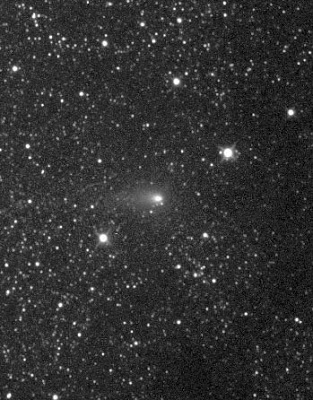
Comet C/2007 N3 (Lulin), discovered in July 2007, should be the highlight comet of this season. It's predicted to reach about 5th magnitude in late February, so it should be easily seen in binoculars. It may even become detectable with the unaided eye in a dark, moonless sky.

Below is a calendar of the comet's doings in the coming weeks (and here's an ephemeris). But don't assume that the brightnesses are trustworthy. The comet's brightness behavior may be unpredictable, because it's on a nearly parabolic orbit that suggests this is its first visit to the inner solar system. You never know what a pristine comet might do.

January: Pre-dawn, and Brightening

The comet spends January rapidly getting higher and brighter in the morning sky, as it moves westward from Libra into Virgo. The best time to look is just before the start of morning astronomical twilight. (To find this time for your location, make sure your location and time zone are up to date in our online almanac.)

The beginning of January found Comet Lulin glowing at 7th magnitude, not quite as bright as predicted. It was at perihelion (closest approach to the Sun) on January 10th, at a solar distance of 1.2 a.u. (181 million km). But rather than fading after perihelion, Lulin should brighten as its diminishing distance from us more than compensates for its moving away from the Sun.

Update Jan. 17: Mariano Ribas in Argentina writes: "Despite Moon interference, the comet right now is an easy target for amateur telescopes of 10 to 20 centimeters (4 to 8 inches) and big binoculars here in Buenos Aires, a city with strong light pollution (limiting magnitude about 4). Today, 1½ hours before sunrise, I saw the comet again and estimated its visual magnitude about 7.0, with a coma 3′ in diameter and moderately condensed (DC: 5/6). But no signs of tail."

Update Jan. 21: "Quite visible in 10x50 binocs in spite of the crescent Moon being close," reports Amar Sharma in Bangalore, India. "20x80 binocs gave a better view as a fuzzy globular, and the 8-inch scope did reveal a condensed fuzzy coma ~4-5 arcminutes in diameter."

Update Jan. 22: Still only about mag 6.8 or 7.0 according to reports, about 1 magnitude below predictions.

February: Peak Brightness, Peak Speed

As Comet Lulin nears Earth its speed across the sky will increase. The beginning of February sees the 6th- or 7th-magnitude comet rising around midnight, and it passes within 1° of the wide binocular double star Alpha Librae on the night of February 5–6. Initially moving at about 1° per day, Lulin will be creeping westward at 2° per day by February 11th, when it crosses into Virgo and passes within a quarter degree of Lambda Virginis.

Five days later, on the 16th, comet Lulin — now perhaps 5th or 6th magnitude — will pass 3° north of Spica, and the comet's speed will have increased to 3° per day.

On the night of February 23rd, near its peak brightness, Comet Lulin is passing 2° south-southwest of Saturn.

Lulin's closest approach to Earth, 0.41 a.u. (61 million km), occurs on February 24th, when the comet may reach a peak of magnitude 5. By now it's visible in late evening (after rising around the end of astronomical twilight) and remains in view for the rest of the night.

And it's speeding along at just over 5° per day! That's about 1 arcsecond every 5 seconds of time, enough to show obvious motion during a short telescopic observing session. Similarly, that's 1 arcminute per 5 minutes of time if you're using binoculars.

After that Lulin moves away from both Earth and the Sun, so it fades quickly. The evening of February 27 will see it at 5th or 6th magnitude within 1° of Regulus.

Weird Orbital Geometry

Strangely, as you may have noticed on the charts, this comet is traveling almost exactly along the ecliptic — backward! Could this really be just be a coincidence? The comet's nearly parabolic orbit indicates that it has never really interacted with the planets at all. Yet its orbital inclination is 178.4°, meaning that it's orbiting in the opposite direction from the planets just 1.6° from the ecliptic plane. (Manipulable 3-D orbit diagram).

Tails and Antitails

Because the comet stays nearly on the ecliptic, its tail (which points away from the Sun) aligns with the ecliptic and with the comet's own direction of motion across the sky. This is indicated by the direction the tail is pointed on the comet symbols on the finder charts linked to above.

Moreover, because Earth remains in the comet's own orbital plane, we're likely to see the comet with a very thin tail and an antitail, a spike pointing in almost the opposite direction from the main tail, for months on end. Why? In three dimensions a comet's dust tail is often wide but it's always thin, confined to the comet's orbital plane. When we are in or near this plane, we can sometimes see parts of the wide, thin dust tail on opposite sides of the comet's head. We pass through most comets' orbital planes briefly. But this time, the situation will last and last.

And indeed, as of January 7th Lulin did have an antitail, as shown in this image taken by Karzaman Ahmad in Malaysia with a 20-inch scope (image courtesy Spaceweather.com.) Here's another image, from Ernesto Guido, Giovanni Sostero and Paul Camilleri, taken January 8th. Here's an animation by Guido and Sostero showing the comet's motion between two images taken Jan. 16th and 17th, antitail and all. Here's a photo gallery of more.

A comet's blue-green gas tail, on the other hand, always points nearly in a straight line away from the Sun in space. Cometary gas is blown directly away from the Sun at high speed by the solar wind.

March: Following Lulin Out

Comet Lulin crosses from Leo into Cancer at the beginning of March. The night of March 5 sees the 6th-magnitude comet within 2° of both Delta (δ) Cancri and the Beehive Cluster (M44). It will make for a fine sight, particularly in high-powered binoculars. Think photo opportunity.

Another nice conjunction occurs on March 16th when the comet, now around 7th or 8th magnitude (and setting in the early hours of the morning), is 1° from Delta Geminorum.

As Comet Lulin recedes, its passage across our sky will slow. Indeed, from the end of March to the end of May (when Lulin may have faded to 11th magnitude) it will stay within a narrow, 3° strip of sky bounded by Epsilon (ε), Mu (μ), and 36 Geminorum.

Comet Lulin won't return again to the inner solar system for more than a thousand years.

Cooperative Discovery

Comet C/2007 N3 (Lulin) was discovered by Quanzhi Ye, a student (age 19) at Sun Yat-sen University in mainland China, as an apparently asteroidal object on images taken by Chi Sheng Lin (National Central University, Taiwan) with a 16-inch telescope at Lulin Observatory in Taiwan on the night of July 11, 2007. A week later, confirming images revealed the telltale presence of a coma. In China and Taiwan, the comet has been hailed as the "Comet of Cooperation."

Lulin was one of 223 comet discoveries on images taken from the ground and in space in 2007, an all-time record.

For a gallery of images and a light curve, check the Comet Lulin page on Seiichi Yoshida's Weekly Information about Bright Comets.
________________________________
Postscript: What Happened to Comet Boethin?

Another comet was expected to be visible in binoculars around this time: Periodic Comet 85P/Boethin. Discovered in 1975 by the late Rev. Leo Boethin (1912–98) in the Philippines, this comet orbits the Sun every 11 years. Or at least it used to.

Comet Boethin was recovered in 1985 and was predicted to brighten to no more than 12th magnitude during the winter of 1985–86 (when comet watchers were enjoying the buzz of Halley). However, it managed to surprise, reaching 7th magnitude in January 1986!

Did this outburst disrupt it completely? Comet Boethin was on track to return in 1997, but the poor circumstances of that return meant it could not be sighted. Nevertheless, astronomers decided in 2005 to redirect the Deep Impact spacecraft (now renamed the EPOXI mission) to study this comet, as its orbital path was ideal for the spacecraft.

In 2007 observers around the world and in space started searching for Comet Boethin, but to no avail. Not even a fragment has been found. Perhaps some tiny faint bit will be picked up by patrol telescopes in early 2009. But as of December 1, 2008, there was still no trace of it to 20th magnitude.

Fortunately, the EPOXI mission has now been redirected to the short-period comet 103P/Hartley 2. This one has been seen at four apparitions, so its orbit is secure.

This is not the first time that a periodic comet has been seen on two returns only to be lost. One example in the last century was 34D/Gale, discovered in 1927 from the inner suburbs of Sydney, Australia. It was recovered in 1938 but never seen again. Like Boethin, it too, coincidentally, had a period of 11 years.

Sky & Telescope.