Total Pageviews

Tuesday, 7 July 2009

40th Anniversary Of Apollo 11

Click on all picture links to see them...


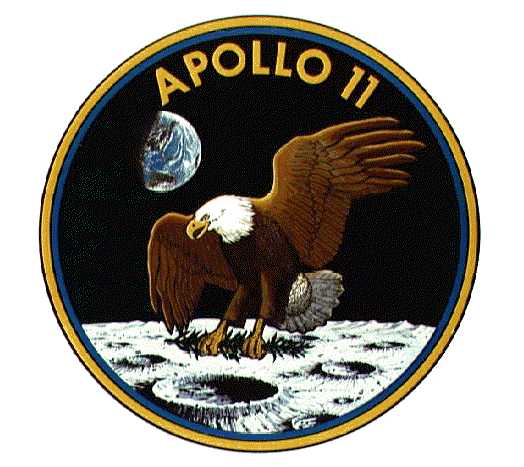
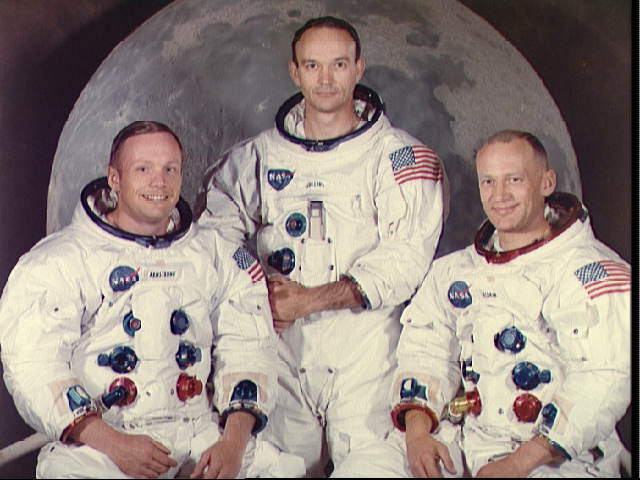
[Apollo 11 Logo] [Crew of Apollo 11]

40th anniversary of Apollo 11 : 1969 - 2009


The picture above shows the crew of Apollo 11: Commander Neil A. Armstrong, 38, a civilian who'd flown previously on Gemini 8, Command Module Pilot Michael Collins, 38, a USAF Lt. Colonel who'd flown Gemini 10, Lunar Module Pilot Edwin E. Aldrin, Jr., 39, a USAF Colonel who'd flown Gemini 12. Photograph taken May 1, 1969.
(NASA photo ID S69-31739)
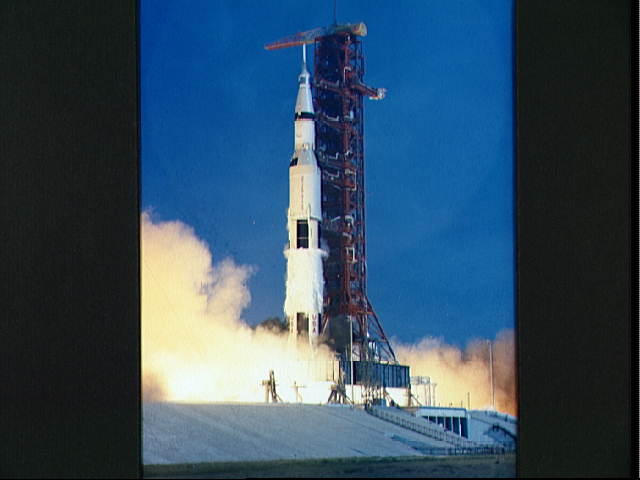

Apollo 11 liftoff

The first human journey to the surface of the Moon began at Pad A, Launch Complex 39, Kennedy Space Center, Florida with the liftoff of Apollo 11 on a Saturn V booster at 9:32 a.m. EDT (13:32 UT) on a clear sunny Wednesday, 16 July 1969.
(NASA photo ID S69-39525)
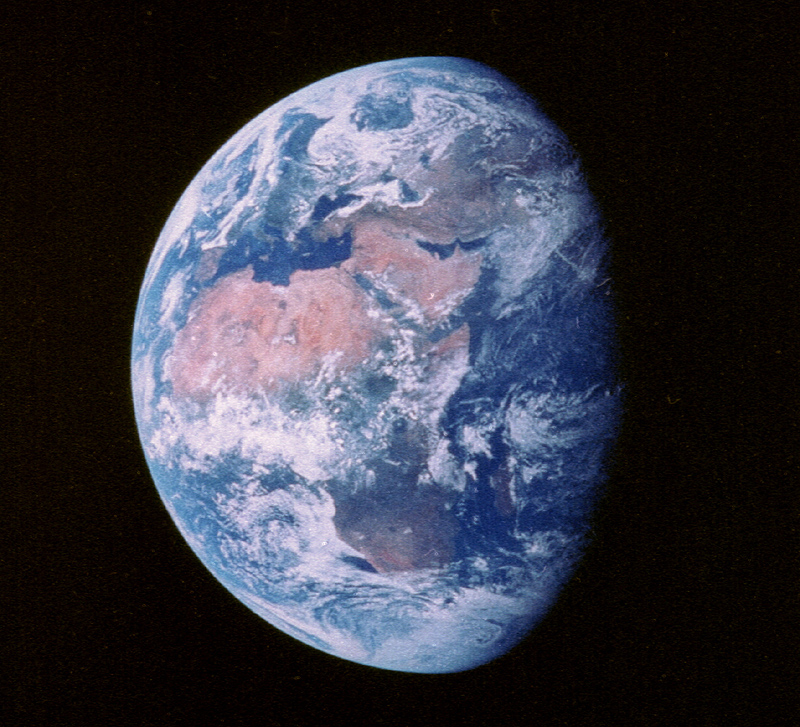

Earth from Apollo 11

The Apollo spacecraft reached Earth parking orbit after 11 minutes. After one and a half orbits the Saturn thrusters fired and the astronauts began their journey to the Moon. This spectacular photo of the Earth was taken from 158,000 km (98,000 miles) during the Apollo 11 translunar injection on July 16. Most of Africa and parts of Europe and Asia are visible.
(NASA photo ID AS11-36-5355)
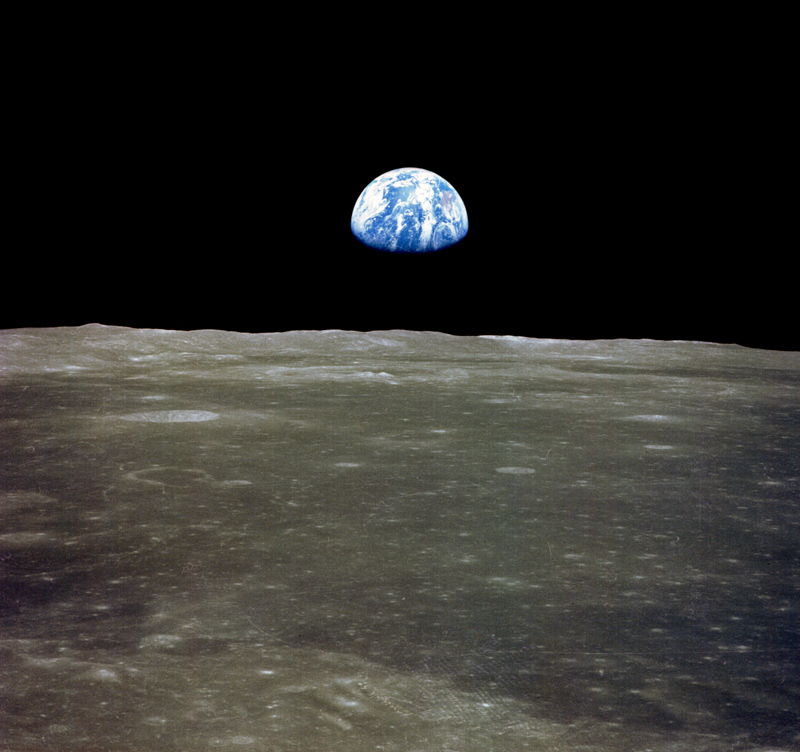

Earthrise

On July 20, 1969, after a four day trip, the Apollo astronauts arrived at the Moon. This photo of Earthrise over the lunar horizon taken from the orbiting Command Module is one of the most famous images returned from the space program, although even the astronauts themselves cannot remember who actually took the picture. The lunar terrain shown, centered at 85 degrees east longitude and 3 degrees north latitude on the nearside of the Moon is in the area of Smyth's Sea.
(NASA photo ID AS11-44-6552)
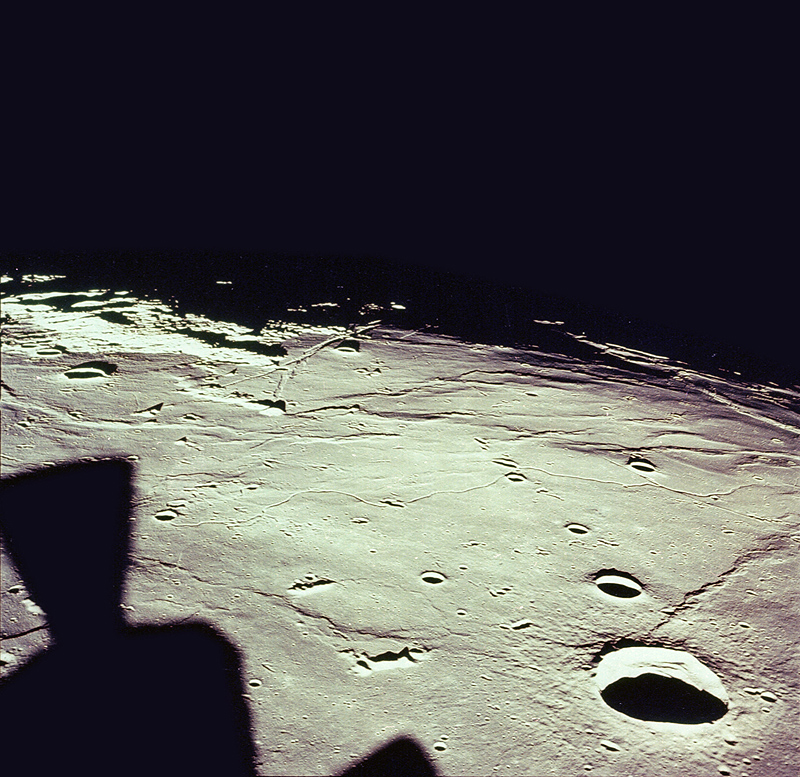

LM view of landing area

This west-looking image of the landing site in the southwestern Sea of Tranquility was taken from the lunar module one orbit before descent, while still docked to the command module. The Tranquility base site is near the shadow line, just to the right of center. The large crater at the lower right is Maskelyne. The large black object in the lower left is not a shadow but a LM thruster in the camera field of view.
(NASA photo ID AS11-37-5437)
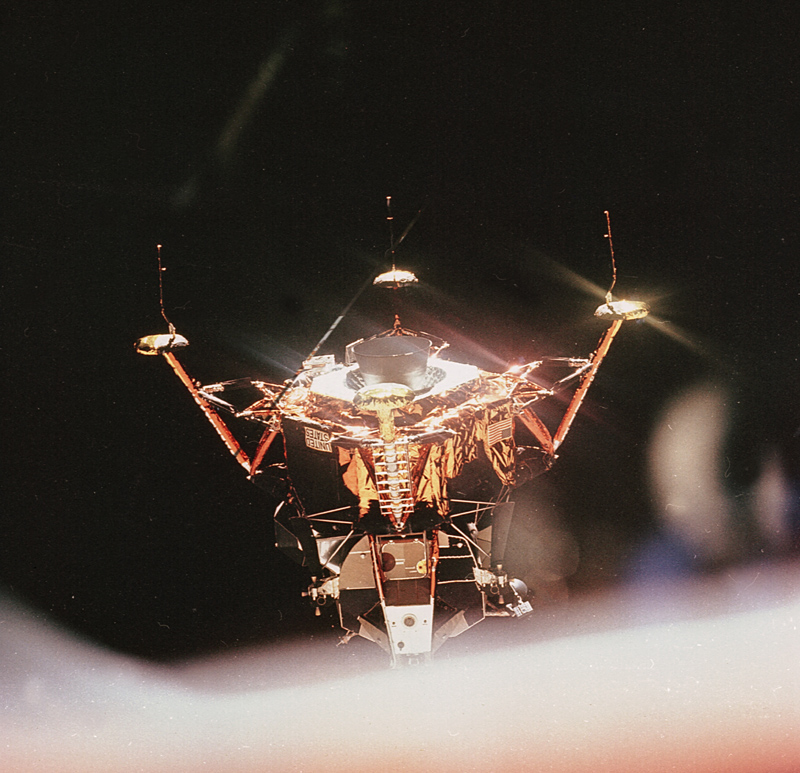

LM after separating from Command Module

At 1:47 pm EDT, July 20, the Lunar Module "Eagle" carrying Neil Armstrong and Edwin Aldrin, separated from the Command Module "Columbia". Michael Collins, aboard the Columbia, took this picture of the LM as it prepared for its descent to the Moon. "You cats take it easy on the lunar surface", Collins said as he released the LM. Collins did a visual inspection of the lunar module and said, "I think you've got a fine looking machine there, Eagle, despite the fact that you're upside-down." "Somebody's upside-down", Armstrong replied. The lunar horizon can be seen in the background.
(NASA photo ID AS11-44-6574)
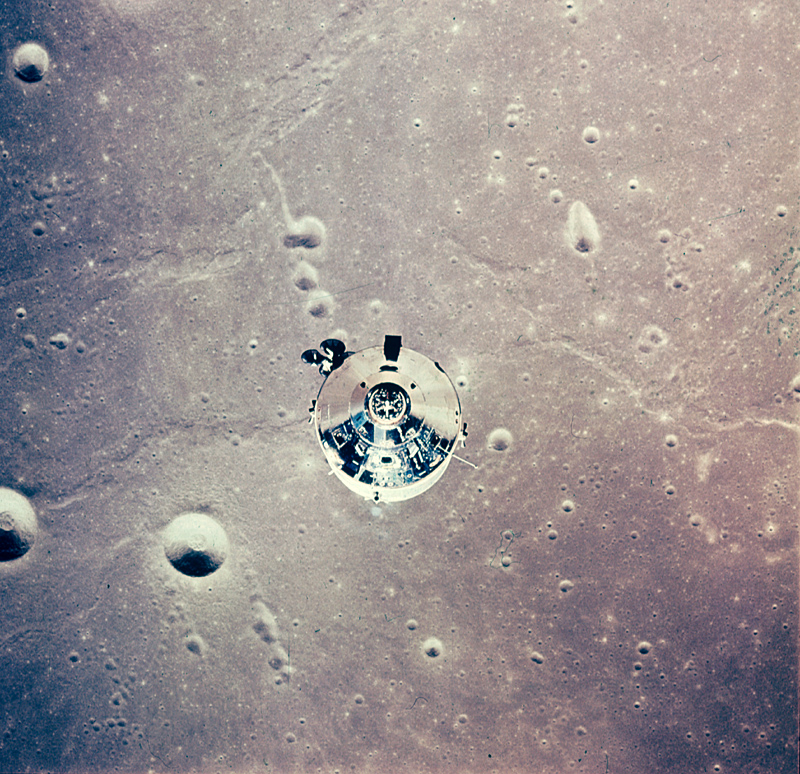

Command Module from LM

This photograph of the Command Module was taken from the LM after separation. The lunar surface below is in the north central Sea of Fertility, centered at 51 degree east longitude, 1 degree north latitude. Over the next day, Michael Collins would orbit the Moon while his colleagues walked on its surface. With no video monitor onboard he could not watch the proceedings but only listen in on the radio communications - and enjoy the sensation of orbiting the Moon solo, the first time anyone had been the only person in lunar orbit.
(NASA photo ID AS11-37-5445)


Image out of LM window after landing

"Houston, Tranquility Base here. The Eagle has landed." These words ushered in a new era of human exploration at 4:18 p.m. EDT on July 20, as the first crewed flight to the Moon touched down after flying longer than planned, down to the last 40 seconds of fuel, to avoid a field of boulders and a large crater. Charles Duke, the Capcom (capsule communicator) back in Houston, replied, "Roger, Tranquility. We copy you on the ground. You got a bunch of guys about to turn blue. We're breathing again." This picture, taken from the LM window shortly before touchdown, shows the surface of the Moon near the touchdown point in the Sea of Tranquility.
(NASA photo ID AS11-37-5458)
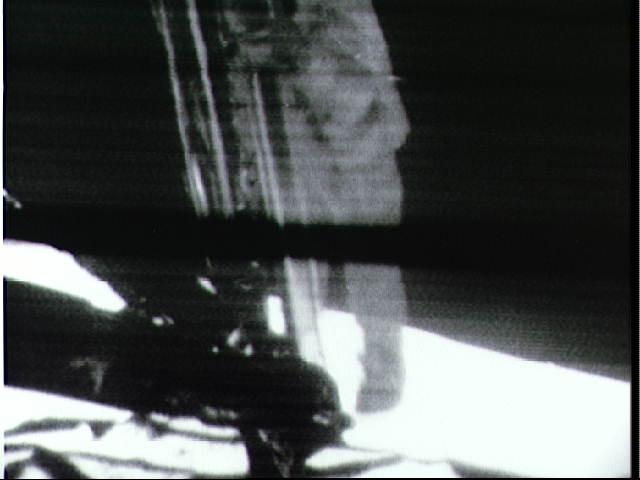

TV image of Armstrong stepping on the Moon

"That's one small step for man, one giant leap for mankind." At 10:56 p.m. EDT on July 20, 1969, Neil Armstrong became the first human to set foot on the Moon. This image was taken from the telecast of the event, watched by over half a billion people around the world. Armstrong composed the quote after landing on the Moon, he had meant to say, "That's one small step for aman ...". The pictures were taken by the Apollo lunar surface camera, mounted on one of the LM legs. The black bar running through the center of the picture is an anomaly in the Goldstone ground data system.
(NASA photo ID S69-42583)
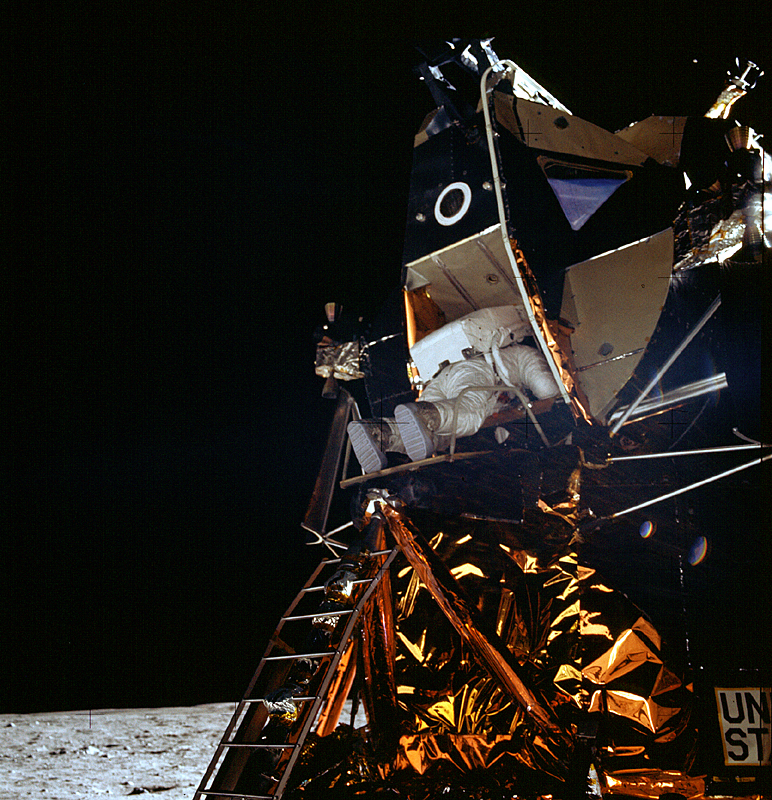
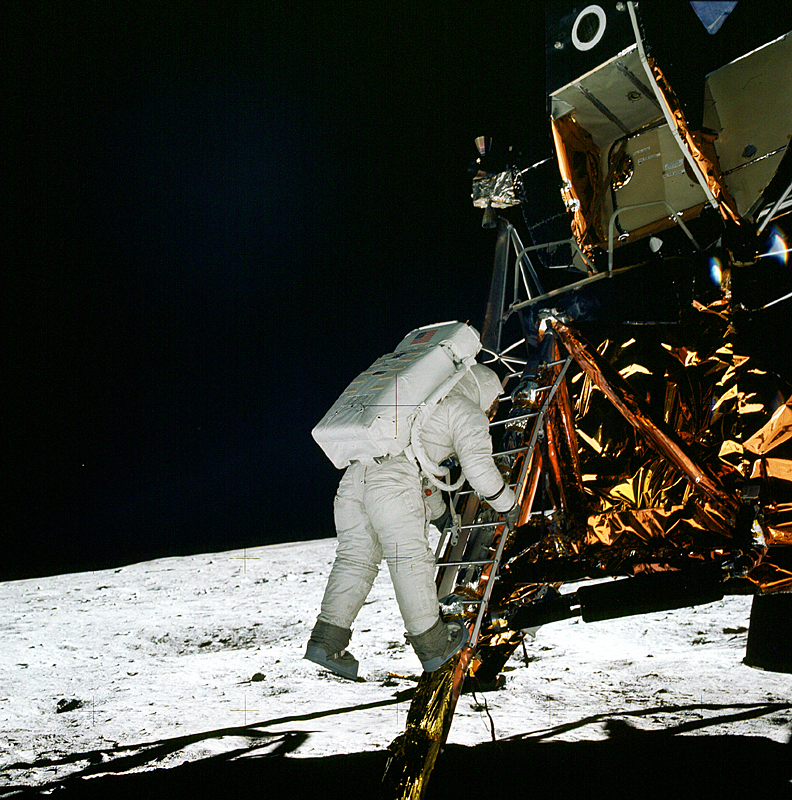
Aldrin exiting hatch Aldrin stepping onto the Moon

Aldrin joined Armstrong on the surface about nineteen minutes later, calling it "Magnificent desolation". As he left the LM, Aldrin said, "Now I want to back up and partially close the hatch - making sure not to lock it on my way out." "A particularly good thought." laughed Armstrong. Asked later on why they bothered closing the hatch, Armstrong said it was to avoid having someone ask "Were you born in a barn?"
(NASA photo IDs AS11-40-5863 and AS11-40-5868)
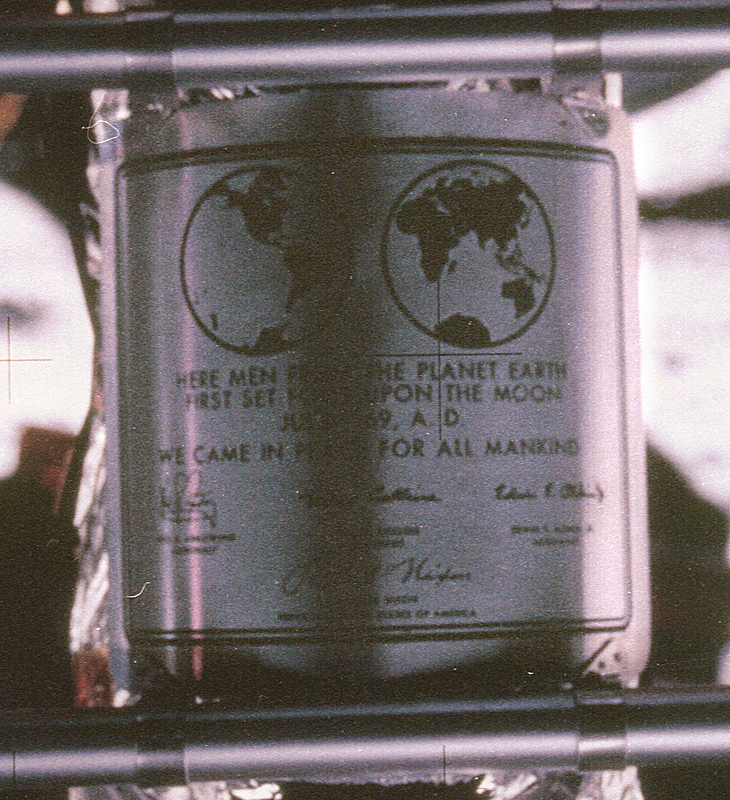

Plaque image

The astronauts removed a sheet of stainless steel to unveil the plaque affixed to the lunar module leg under the descent ladder and read to the television audience: "Here men from the planet Earth first set foot upon the Moon, July 1969 A.D. We came in peace for all mankind." It was signed by Armstrong, Collins, Aldrin, and President Richard Nixon.
(NASA photo ID AS11-40-5899)
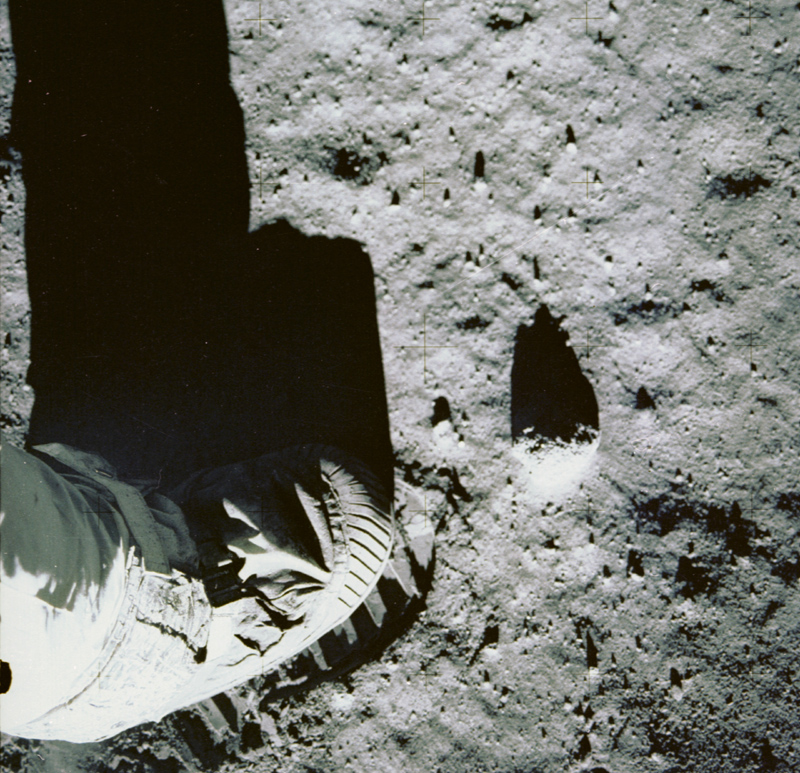
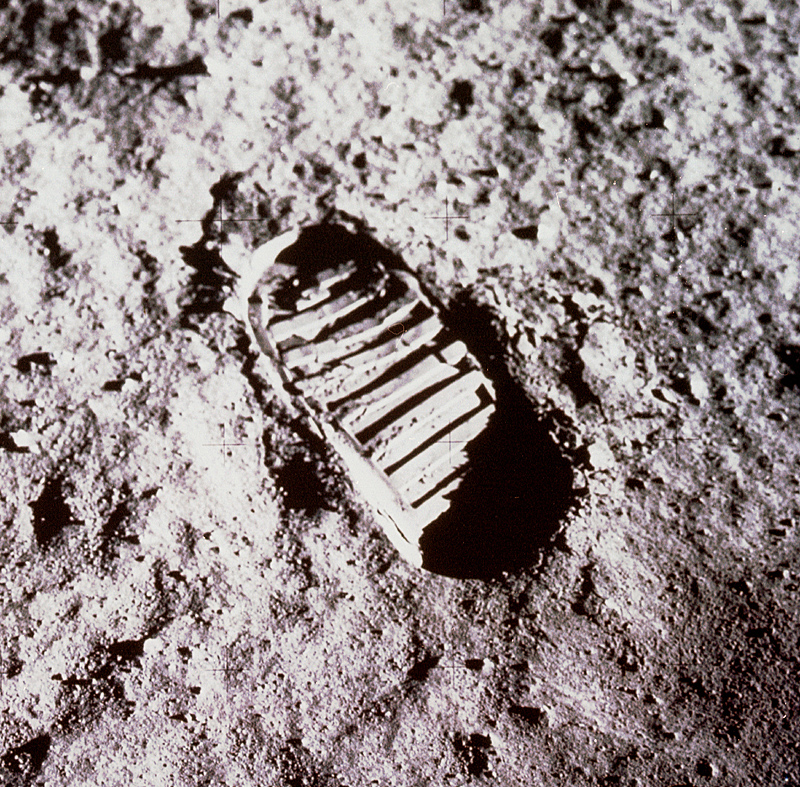
Moon boot and footprint Moon footprint

The footprints left by the astronauts in the Sea of Tranquility are more permanent than most solid structures on Earth. Barring a chance meteorite impact, these impressions in the lunar soil will probably last for millions of years. Photographs of the footprints were actually part of a planned experiment by Aldrin to study the nature of the lunar dust and the effects of pressure on the surface.
(NASA photo ID's AS11-40-5880 and AS11-40-5878)
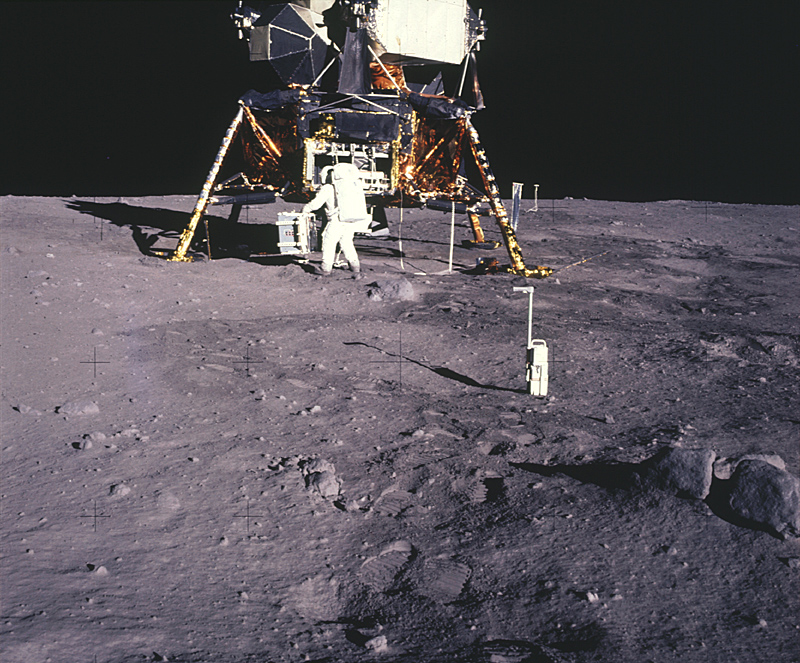

Aldrin deploying EASEP

Here Aldrin is unloading the passive seismometer of the Early Apollo Scientific Experiments Package (EASEP) from the lunar module equipment bay. The white apparatus in the foreground is the 35 mm stereo close-up camera. Beyond the right leg is the solar wind experiment, and beyond that the lunar surface TV camera. The LM legs are wrapped in foil to provide thermal insulation. There is a split rock in the lower right of the frame which is presumably ejecta from a nearby impact crater.
(NASA photo ID AS11-40-5931)


Aldrin setting up experiments

In the couple hours that Aldrin and Armstrong were on the Moon, there was little time to set up scientific experiments, but a small package (the EASEP, or Early Apollo Scientific Experiments Package) was deployed. Aldrin is shown here setting up the Passive Seismic Experiments Package. Behind Aldrin to the left is the Laser Ranging Retro-Reflector. The flag and the lunar surface television camera are left of the LM. This mission paved the way for the more extensive scientific studies done on later Apollo missions.
(NASA photo ID AS11-40-5949)
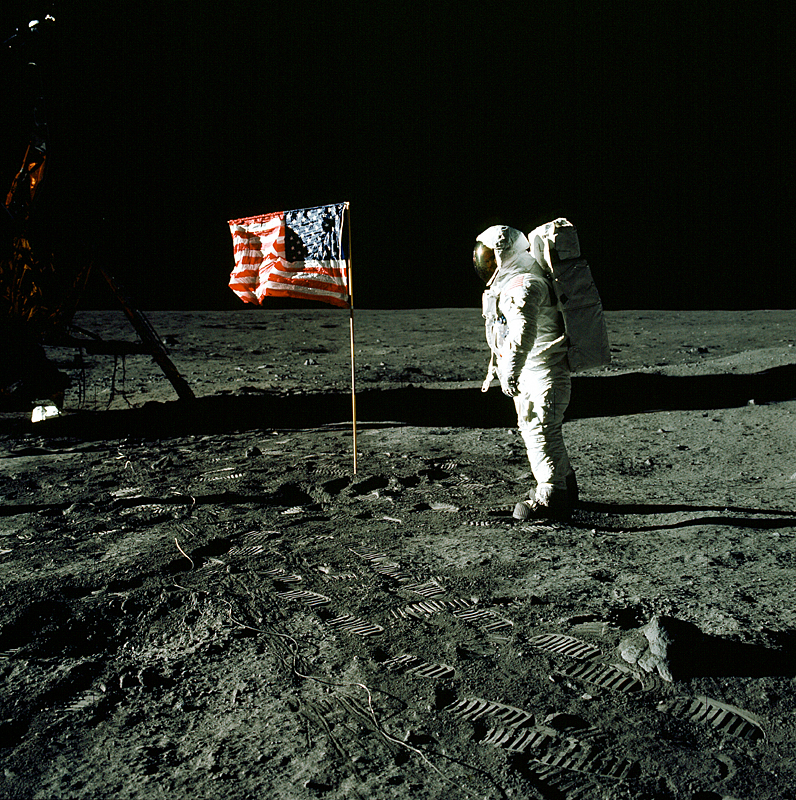

Aldrin and U.S. Flag

Aldrin posed for this picture next to the U.S. flag. The rod to hold the flag out horizontally would not extend fully, so the flag ended up with a slight waviness, giving the appearance of being windblown. The flag itself was difficult to erect, it was very hard to penetrate beyond about 6 to 8 inches into the lunar soil.
(NASA Photo ID AS11-40-5875)
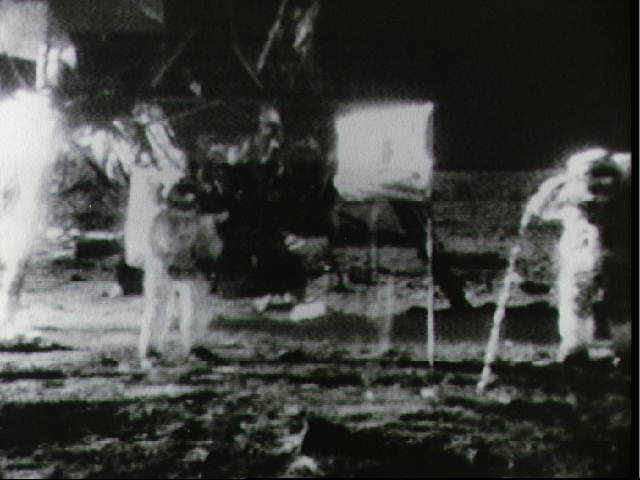

TV image of astronauts on the Moon

Millions of Earthlings watched the drama unfold on TV images taken by the black and white lunar surface camera. Here, Armstrong is standing in the center, and Aldrin is saluting President Richard M. Nixon, who had just spoken to the two astronauts by radio telephone from the White House: "Hello, Neil and Buzz. I'm talking to you by telephone from the Oval Room at the White House, and this certainly has to be the most historic telephone call ever made ..... Because of what you have done, the heavens have become a part of man's world .......". Armstrong replied, "Thank you, Mr. President. It's a great honor and privilege for us to be here representing not only the United States but men of peace of all nations, and with interests and the curiosity and with the vision for the future."
(NASA photo ID S69-39562)


Aldrin near LM

Walking on the lunar surface was not difficult, but took a little practice. Despite the fact that the backpacks and astronauts only weighed 1/6 on their 350 pound Earth weight, their center of gravity was shifted so they had to lean slightly forward to balance, and they still had to overcome the inertia of all that mass, so stopping usually took a few steps. Here Aldrin is walking in the typical bent posture near the leg of the lunar module. Footprints are clearly visible in the foreground.
(NASA photo ID AS11-40-5902)
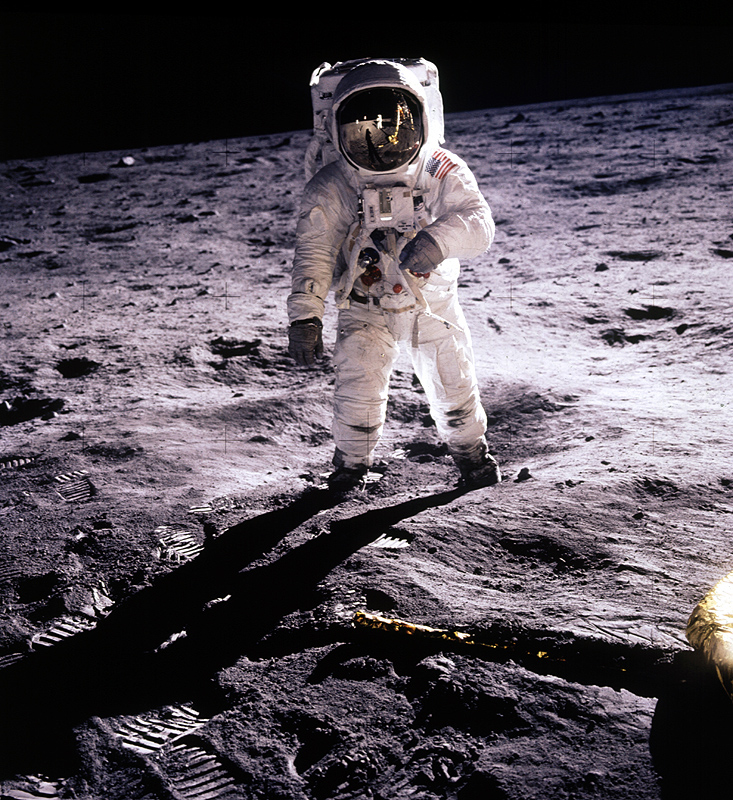

Aldrin reflection picture

Neil Armstrong took this picture of Edwin Aldrin, showing a reflection in Aldrin's visor of Armstrong and the Lunar Module. This is one of the few photographs showing Armstrong (who carried the camera most of the time) on the Moon. The tasks assigned to both astronauts were carefully choreographed and practiced back on Earth, and Aldrin was busy setting up scientific experiments among other responsibilities. Apparently taking pictures was not as carefully planned. Aldrin later said, "My fault, perhaps, but we had never simulated this in training."
(NASA photo ID AS11-40-5903)
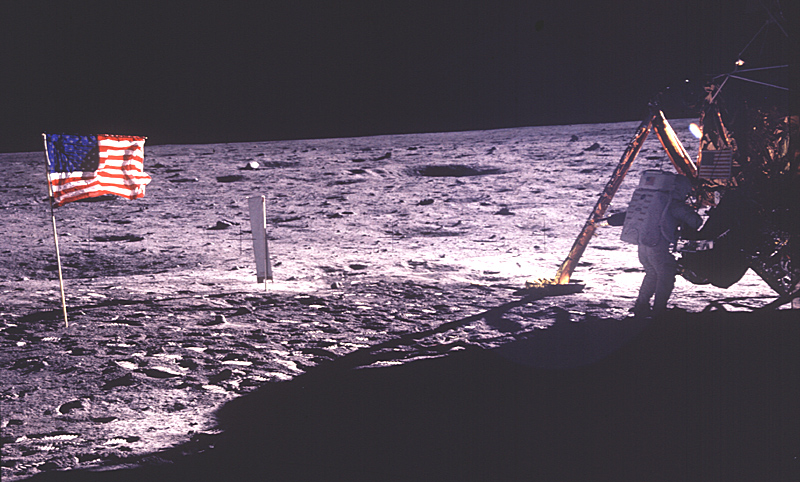

Armstrong standing at LM

Armstrong was photographed here at the Modular Equipment Stowage Assembly (MESA) on the lunar module, packing the bulk rock and soil sample he had collected. Aldrin took this picture as part of a series of panoramas of the area around the Tranquility Base landing site. Armstrong is in the shadow of the lunar module, details can only be seen with processing, making the sunlit surface directly behind the LM appear very bright.
(NASA photo ID AS11-40-5886)
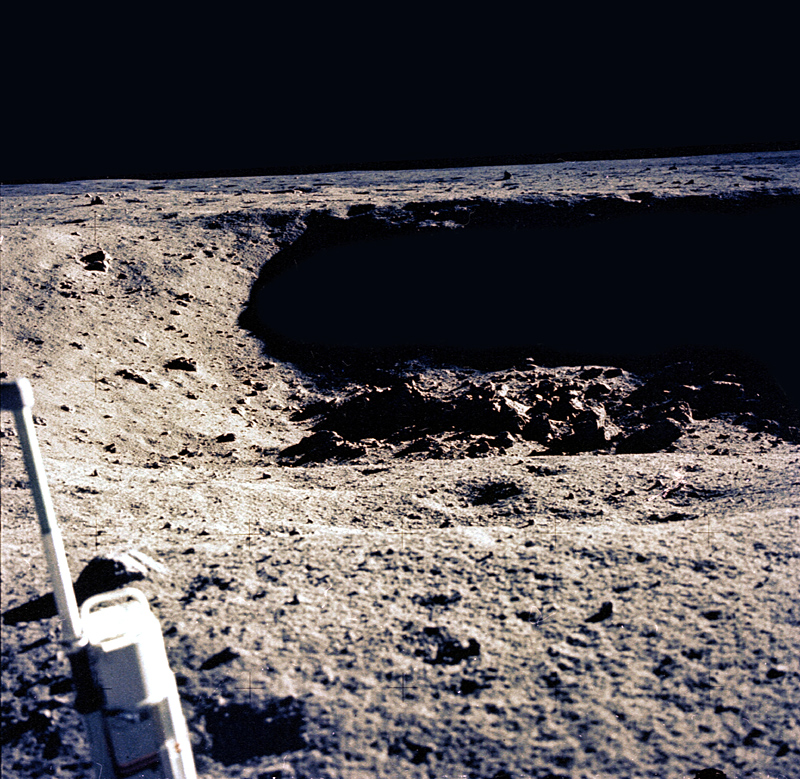

East Crater

At one point Armstrong disappeared from the TV camera for about 3 minutes to photograph East Crater about 60 meters away from the LM. He estimated the crater was about 70 or 80 feet in diameter and 15 or 20 feet deep. The crater wall in the background is in deep shadow. The object at lower left is the stereo close-up camera.
(NASA photo ID AS11-40-5954)


US flag on the Moon

The astronauts returned to the Lunar Module after 2 hours and 32 minutes on the surface and took this picture. The footprints of the astronauts and the lunar surface television camera can be seen. The flag was actually knocked over when by the LM's exhaust when the astronauts took off from the Moon at 1:54 p.m. EDT on July 21.
(NASA photo ID AS11-37-5545)
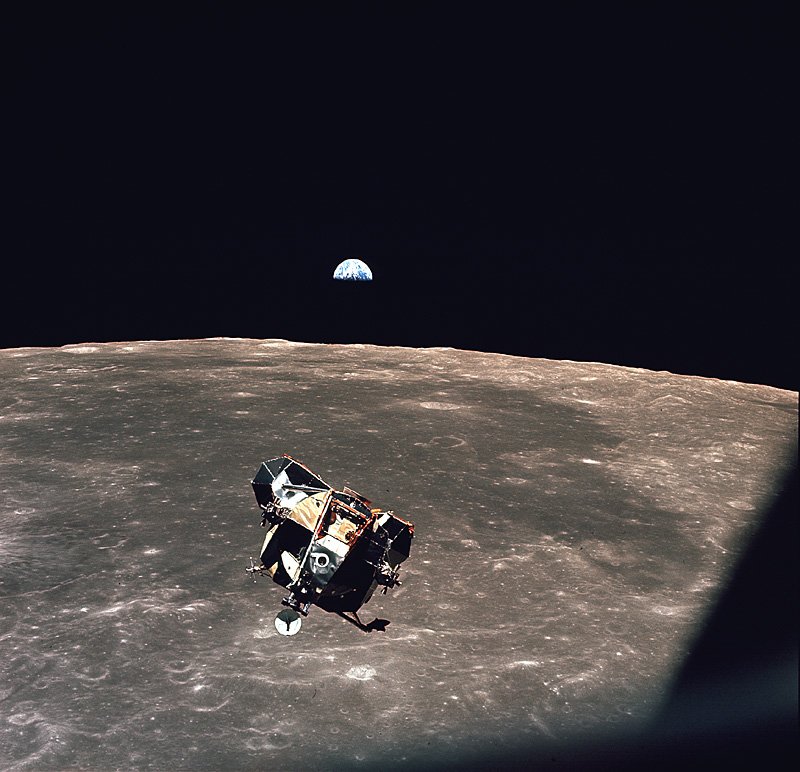

Return of Lunar Module

After lifting off from the lunar surface, the lunar module made its rendezvous with the command module. The Eagle docked with Columbia, and the lunar samples were brought aboard. The LM was left behind in lunar orbit while the three astronauts returned in the command module to the blue planet in the background.
(NASA photo ID AS11-44-6642)
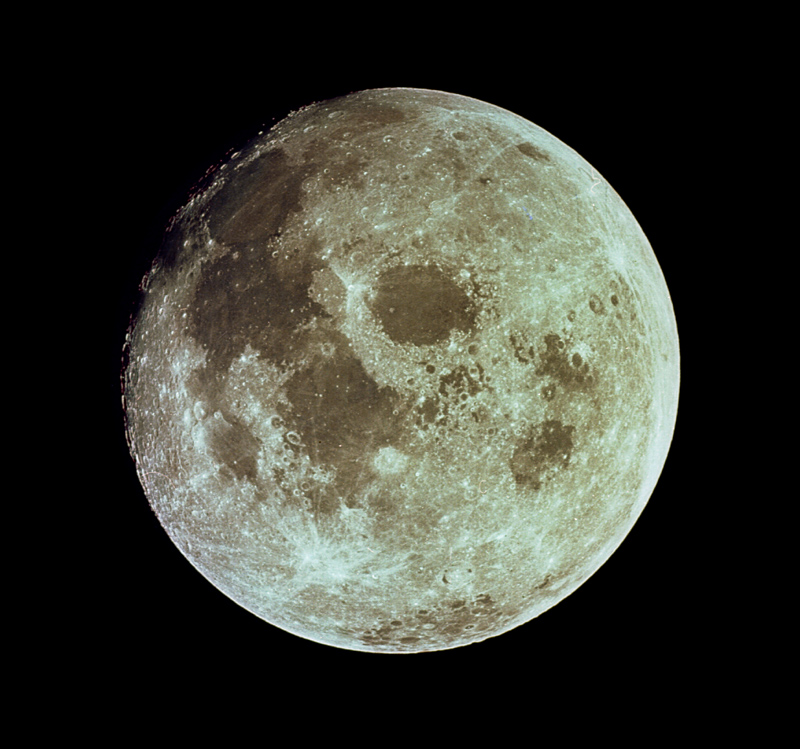

Full Moon from Apollo

View of a full Moon photographed from the Apollo 11 spacecraft during its transearth journey homeward. When this picture was taken the spacecraft was about 10,000 nautical miles from the Moon, after a successful burn of the command/service module main engine to leave lunar orbit. After a two and a half day coast the astronauts would re-enter Earth's atmosphere.
(NASA photo ID AS11-44-6667)
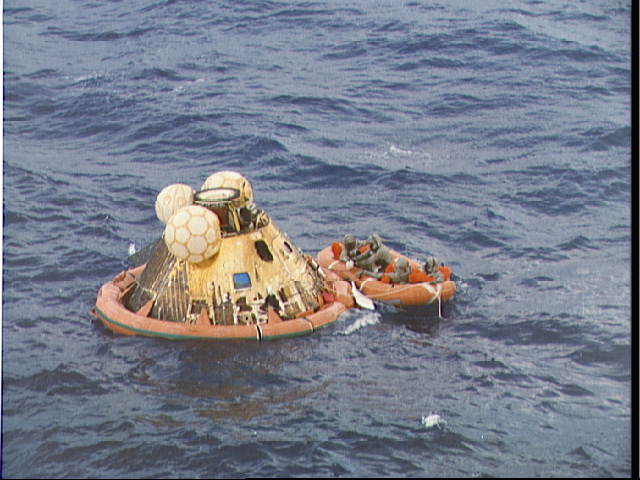

Splashdown - recovery of astronauts

The final phase of Kennedy's challenge was completed at 12:50 p.m. EDT on July 24, 1969, when the Columbia splashed down about 812 nautical miles southwest of Hawaii, returning the 3 astronauts safely to Earth. Here they are shown in a life raft with a Navy frogman. All four men are wearing biological isolation garments, awaiting helicopter pickup and transport to the U.S.S. Hornet. They stayed in quarantine for three weeks. The day before splashdown, Aldrin said, "We feel this stands as a symbol of the insatiable curiousity of all mankind to explore the unknown." It also stands as a tribute to the thousands of engineers, scientists, and others who made the journey possible with their extraordinary efforts.
(NASA photo ID S69-21698)


To order hardcopy versions of any of the AS11- images above, contact the NSSDC Request Office at request@nssdc.gsfc.nasa.gov, (301) 286-6695.

 the Apollo 11 home page
 Apollo 11 Mission Summary
 the Apollo home page
 Three asteroids named for Apollo 11 crew

Other Apollo 11 sites:

 Apollo 11 30th Anniversary Page - NASA History Office
 Apollo 11 30th Anniversary - List of Events
 The First Lunar Landing - Astronauts' Post-Flight Press Conference
 Apollo 11 images at Johnson Space Center
 Apollo 11 Lunar Surface Journal - Transcript of Apollo 11 communications
 Washington goes to the Moon - American University Radio
 Apollo 11 Mission Overview - Lunar and Planetary Institute
 Apollo 11 Mission Summary - Kennedy Space Center
 Apollo 11 Information - National Air and Space Museum
 Apollo 11 30th Anniversary - National Space Society
 Apollo 11 30th Anniversary - Boeing


In memory of the irrepressible Charles "Pete" Conrad, June 2, 1930 - July 8, 1999.
Gemini 5 and 11, Apollo 12, Skylab. Third astronaut to walk on the Moon.
"Whoopie! Man, that may have been a small one for Neil, but that's a long one for me!"

[NASA Logo]

Author/Curator:
Dr. David R. Williams, dave.williams@nasa.gov
NSSDC, Mail Code 690.1
NASA Goddard Space Flight Center
Greenbelt, MD 20771
+1-301-286-1258


NASA Official: Ed Grayzeck, edwin.j.grayzeck@nasa.gov
Last Updated: 24 May 2005, DRW

The Man In The Moon


The Apollo Program (1963 - 1972)


30th Anniversary of Apollo 11 - July, 1999

The Apollo program was designed to land humans on the Moon and bring them safely back to Earth. Six of the missions (Apollos 11, 12, 14, 15, 16, and 17) achieved this goal. Apollos 7 and 9 were Earth orbiting missions to test the Command and Lunar Modules, and did not return lunar data. Apollos 8 and 10 tested various components while orbiting the Moon, and returned photography of the lunar surface. Apollo 13 did not land on the Moon due to a malfunction, but also returned photographs. The six missions that landed on the Moon returned a wealth of scientific data and almost 400 kilograms of lunar samples. Experiments included soil mechanics, meteoroids, seismic, heat flow, lunar ranging, magnetic fields, and solar wind experiments.

Click on the spacecraft name for information about the spacecraft and data held at NSSDC

Apollo Lunar Missions

Apollo 8

Launched 21 December 1968
Lunar Orbit and Return
Returned to Earth 27 December 1968

Apollo 10

Launched 18 May 1969
Lunar Orbit and Return
Returned to Earth 26 May 1969

Apollo 11

Launched 16 July 1969
Landed on Moon 20 July 1969
Sea of Tranquility
Returned to Earth 24 July 1969

Apollo 12

Launched 14 November 1969
Landed on Moon 19 November 1969
Ocean of Storms
Returned to Earth 24 November 1969

Apollo 13

Launched 11 April 1970
Lunar Flyby and Return
Malfunction forced cancellation of lunar landing
Returned to Earth 17 April 1970

Apollo 14

Launched 31 January 1971
Landed on Moon 5 February 1971
Fra Mauro
Returned to Earth 9 February 1971

Apollo 15

Launched 26 July 1971
Landed on Moon 30 July 1971
Hadley Rille
Returned to Earth 7 August 1971

Apollo 16

Launched 16 April 1972
Landed on Moon 20 April 1972
Descartes
Returned to Earth 27 April 1972

Apollo 17

Launched 07 December 1972
Landed on Moon 11 December 1972
Taurus-Littrow
Returned to Earth 19 December 1972

The Apollo mission consisted of a Command Module (CM) and a Lunar Module (LM). The CM and LM would separate after lunar orbit insertion. One crew member would stay in the CM, which would orbit the Moon, while the other two astronauts would take the LM down to the lunar surface. After exploring the surface, setting up experiments, taking pictures, collecting rock samples, etc., the astronauts would return to the CM for the journey back to Earth.

Apollo Crewed Earth Orbiting Missions

Apollo 7

Launched 11 October 1968
First crewed Apollo flight
Splashdown 22 October 1968

Apollo 9

Launched 03 March 1969
First crewed Lunar Module test
Splashdown 13 March 1969

The Apollo 1 Launch Pad Accident

Apollo 1

27 January 1967
Tragic Loss of Three Apollo Astronauts

Apollo/Saturn Uncrewed Earth Orbiting Missions

SA-5

Launched 29 January 1964
First Block II Saturn launch

SA-6

Launched 28 May 1964
First Apollo boilerplate model

SA-7

Launched 18 September 1964
Apollo boilerplate model

SA-9/Pegasus 1

Launched 16 February 1965
Apollo boilerplate model and micrometeoroid satellite

SA-8/Pegasus 2

Launched 25 May 1965
Apollo boilerplate model and micrometeoroid satellite

SA-10/Pegasus 3

Launched 30 July 1965
Apollo boilerplate model and micrometeoroid satellite

AS-203

Launched 5 July 1966
First S-IVB stage orbital mission

Apollo 4

Launched 9 November 1967
First all-up launch of Saturn V

Apollo 5

Launched 22 January 1968
First test of Lunar Module in space

Apollo 6

Launched 4 April 1968
Final uncrewed Apollo test flight

Apollo/Saturn Uncrewed Suborbital Flights

SA-1

Launched 27 October 1961
First flight of Saturn 1

SA-2

Launched 25 April 1962
Project High Water I

SA-3

Launched 16 November 1962
Project High Water II

SA-4

Launched 28 March 1963
Engine-out capability test

AS-201

Launched 26 February 1966
First flight of Saturn 1B

AS-202

Launched 25 August 1966
Apollo development flight


 More details on Apollo lunar landings
 Precise positions of LM's and science experiments on the Moon
 Impact sites of the Apollo LM's and SIVB's
 Where are they now? - A guide to the current locations of the Apollos
 The Apollo Lunar Roving Vehicles - Apollo 15, 16, and 17
 Lunar home page
 The Apollo 8 Christmas Eve Broadcast
 30th Anniversary of the Apollo 11 mission - Images, audio clips, and a brief history.
 Lunar Landing Site Map - Map showing landing sites of the Apollo, Luna, and Surveyor missions
 The Apollo 11 mission - 25th Anniversary
 The Apollo 13 malfunction - Images and information on the accident
 The Apollo 14 Moon Trees - Trees grown from seeds brought to the Moon by Apollo 14
 The Apollo 15 Hammer/Feather Drop
[*] The Apollo 17 LM liftoff from the Moon (80 K Quicktime movie) and a 1 Mbyte version
 Apollos 18, 19, and 20 - The cancelled missions
 Restored ALSEP Data - Suprathermal Ion Detector Experiment
 Did the Apollo astronauts really land on the Moon?

 Chronology of U.S. Astronaut Missions - Mercury, Gemini, and Apollo

 Apollo Images - Johnson Space Center
 Apollo Lunar Surface Journal - Transcripts of Apollo communications
 Apollo Missions - Lunar and Planetary Institute
 The Apollo Program - Smithsonian National Air and Space Museum
 Apollo: Mission to the Moon - Kennedy Space Center
 Apollo History - Kennedy Space Center
 Planetary Materials Curation - Lunar samples at Johnson Space Center
 Lunar Module - Spacecraft Assembly and Test Page (No active link, Archived from 27 April 2006)

Apollo Books Online

 Apollo Expeditions to the Moon
 Where No Man Has Gone Before: A History of Apollo Lunar Exploration Missions
 Apollo by the Numbers: A Statistical Reference
 Apollo Over the Moon: A View From Orbit
 Moonport: A History of Apollo Launch Facilities and Operations
 Chariots for Apollo: A History of Manned Lunar Spacecraft
 Apollo: A Retrospective Analysis
 The Apollo Spacecraft Chronology, Vol. I - IV
 Catalog of Apollo Experiment Operations
 An Annotated Bibliography of the Apollo Program
 On the Moon with Apollo 16: A Guidebook to the Descartes Region
 Stages to Saturn: A Technological History of the Apollo/Saturn Launch Vehicles
 Apollo Program Summary Report (PDF Files)
 Apollo Preliminary Science Reports
 Apollo Press Kits (Kennedy Space Center)
 Apollo Scientific Experiments Data Handbook (NSSDC, PDF File)
 ALSEP Termination Report (NSSDC, PDF FIle)

[NASA Logo]
Author/Curator:
Dr. David R. Williams, dave.williams@nasa.gov
NSSDC, Mail Code 690.1
NASA Goddard Space Flight Center
Greenbelt, MD 20771
+1-301-286-1258


NASA Official: Ed Grayzeck, edwin.j.grayzeck@nasa.gov
Last Updated: 24 November 2008, DRW

Saturday, 4 July 2009

Sunspot Alert

Space Weather News for July 4, 2009
http://spaceweather.com

The sun is putting on its own 4th of July fireworks show. A new sunspot is rapidly emerging in the sun's southern hemisphere and it is crackling with B-class solar flares.  The magnetic polarity of sunspot 1024 identifies it as a member of new Solar Cycle 24.  It appears to be the best offering yet of the young solar cycle.  Check http://spaceweather.com for images and updates.

Tuesday, 30 June 2009

Volcanic Sunset Alert

Space Weather News for June 30, 2009
http://spaceweather.com

VOLCANIC SUNSETS:  The Russian volcano that erupted directly beneath the International Space Station on June 12th is now causing beautiful lavender sunsets across parts of the northern USA and Europe.  A plume of ash and sulfur dioxide from the Sarychev Peak eruption is circulating through the stratosphere,  and when parts of the plume pass over an area at sunset, the sky fills with delicate white ripples, sometimes-colorful streamers, and a telltale hue of purple.  Check today's edition for observing tips and a photo gallery.

Shuttle launch and noctilucent clouds point to Tunguska comet

BY DR EMILY BALDWIN

ASTRONOMY NOW

Posted: 29 June, 2009


The exhaust plume of a shuttle launch that created noctilucent clouds similar to those seen after the Tunguska event supports the theory that a comet, and not a meteoroid, exploded over Siberia one hundred years ago.

"It's almost like putting together a 100-year-old murder mystery," says Cornell University's Michael Kelley, who led the research.

Following the event at Tunguska, and various shuttle launches, brilliant, night-visible clouds, or noctilucent clouds were observed. Noctilucent clouds, or NLCs for short, are high altitude thin sheets of clouds that reflect sunlight when the Sun is between six and sixteen degrees below the horizon.

The shuttle's launch exhaust creates a dazzling view over the Vehicle Assembly Building an hour after liftoff. Image: Ben Cooper/Spaceflight Now.

After the June 1908 explosion the night skies shone brightly for many days, notably in the UK, almost 5,000 kilometres away. Recent interpretations suggest these "glowing skies" were the result of NLCs.

The same NLC phenomenon was also observed after space shuttle launches in 1997, 2003 and 2007. A single space shuttle flight injects 300 metric tons of water vapor into the Earth's upper atmosphere, and the water particles have been found to travel to the Arctic and Antarctic regions, where they form clouds after settling at lower altitudes.

According to Kelley and colleagues, the shuttle exhaust plume resembled the same action as a comet breaking up and depositing vast amounts of water vapor into the atmosphere. They contend that the Tunguska comet would have started to break up at about the same altitude as the release of the exhaust plume from the space shuttle following launch. Just as the water particles from the shuttle found themselves in the polar regions, the cometary ice would have been swept up in eddies in the atmosphere and transported thousands of kilometres around the globe.

Felled trees as seen by one of the first expeditions to the Tunguska blast area. Image: University of Bologna, http://www-th.bo.infn.it/tunguska/.

The scientists have attempted to answer how this water vapor traveled so far without scattering and diffusing, as conventional physics would predict. "There is a mean transport of this material for tens of thousands of kilometres in a very short time, and there is no model that predicts that," says Kelley. "It's totally new and unexpected physics."

This "new" physics, the researchers contend, is tied up in
counter-rotating eddies with extreme energy that distributes the water around the globe extremely rapidly. "Our observations show that current understanding of the mesosphere-lower thermosphere region is quite poor," says co-author Charlie Seyler. The Earth's atmosphere is split into layers, with the troposphere extending from the surface, followed by the stratosphere, mesosphere, thermosphere and exosphere. The International Space Station orbits in the thermosphere at an altitude of around 350 kilometres.

Scientists have long argued the composition of the Tunguska impactor, falling into the two main camps of asteroid or comet. Either way, the explosion of the body was enough to flatten some two thousand square kilometres of forest and provide one hundred years worth of study and speculation.

The Cornell University researchers will present their research in the Geophysical Research Letters journal.

Monday, 29 June 2009

Let’s go back to the moon – and beyond

Monday 29 June 2009

As the 40th anniversary of the first manned moon landing approaches, backward attitudes here on Earth have tainted our view of lunar exploration.
James Woudhuysen

America, Japan, China and India have all begun what the Wall Street Journal calls 'The new race for the moon' (1). No doubt their motives aren't wholly pure; but it is those who attack the whole idea of lunar missions who most deserve criticism right now, for they too are in the ascendant. A popular, of-the-moment example is the new anti-capitalist movie, Moon. Describing it as a warning 'that couldn't be more timely', a contributor to the influential online magazine Slate insists, simply, 'Stay off the moon!' (2).

One thing unites the critics of lunar exploration. Forty years after man first landed on the moon – on 20 July 1969 – they share a disdain for the grandeur of extra-terrestrial endeavour; for the scale of human ambition involved; for the very idea that human beings should climb into space, as up a mountain, 'because it is there'.

I have no special preference for size, thrust during lift-off, or the traverse across vast distances. The development of the integrated circuit in the late 1950s, so important to the Apollo programme, was a tribute to miniaturisation rather than to high energy or physical scale. No, my admiration for both Saturn boosters and tiny electronics grows from a respect for open-ended curiosity, for human achievement, and for taking risks. With space travel, a lot of bravery was also at stake. And with both space and the development of semiconductors, there is much teamwork to celebrate – teamwork that, in the case of Apollo, involved not just three astronauts, but the efforts of hundreds of thousands of people.

List of Apollo moon landings:

Apollo 11:
16 July 1969 Success - first manned landing on the Moon (manual landing required), exploration on foot in direct vicinity of landing site.

Apollo 12:
14 Nov 1969 Success - mission almost aborted in-flight after lightning strike on takeoff caused telemetry loss, successful landing within walking distance (less than 200 meters) of the Surveyor 3 probe.

Apollo 13:
11 April 1970 Successful Failure - problematic oscillations on start, unrelated explosion in service module during Earth-Moon transition caused mission to be aborted - crew took temporary refuge in lunar module and eventually returned to Earth with command module after single pass around Moon and made it through reentry.

Apollo 14:
31 Jan 1971 Success - software and hardware problems with lunar module almost caused landing abort during lunar orbit, first color video images from the Moon, first materials science experiments in space.

Apollo 15:
26 July 1971 Success - first longer (3 days) stay on Moon, first use of lunar rover to travel (total of 17.25 miles (27.76 km), more extensive geology investigations.

Apollo 16:
16 April 1972 Success - malfunction in a backup yaw gimbal servo loop almost aborted landing (and reduced stay duration on Moon by one day to three for safety reasons), only mission to target lunar highlands.

Apollo 17:
7 Dec 1972 Success - last (and still most recent) manned landing on the Moon, only mission with geologist.

Reasons to stay earthbound

Today's anti-celestial prohibitions haven't really emerged because of new developments off-Earth. Of course, there is more 'space junk' for misanthropes, concerned always with mankind's filthy footprints, to bemoan (3). Also, American and Chinese militarists have redoubled their interest in space warfare (4). However, the main changes informing today's hostility toward space travel relate to terra firma.

Exceeding seven miles per second, the velocity needed to escape gravity, is no longer regarded as a dignified challenge in itself. Instead, even those who favour ventures into space fret about lunar travel today. Back in 2004, as NASA returned to the red planet with its Mars Exploration Rovers, then US president George W Bush tried to don the mantle of John F Kennedy in calling for a renewed conquest of the heavens, and the free-enterprise Hoover Institution, Stanford University, looked forward to 'a new American empire in space'. Yet despite the (very short lived) post-Iraq War atmosphere of American triumphalism in 2004, the Hoover Institution worried about US 'vulnerabilities':

'Entrepreneurial terrorists (pirates, in eighteenth-century terms) will attack the power lines and communications channels on Earth – and eventually in space – that make exploration possible. Space travel will also create vast new energy demands on fossil fuels and other non-renewable resources on Earth. Successful space policy requires that we take serious measures to protect vulnerable communications networks and pursue alternative energy sources.' (5)

Here the attractions of space travel were vitiated, in part, by fears – now reviving, in the face of buoyant oil prices – of 'peak oil'.

In keeping with the new century's premonitions of doom, getting into space is also now seen in desperate, instrumental terms. People worry excessively about energy shortages, and do not have the confidence to believe that solutions are available on Earth – not least, by harnessing the tidal power set off by the moon. As a result, there is more talk, à la Moon, of going lunar to mine an isotope of helium, 3He, as a low-radiation, cheap-to-engineer alternative, in nuclear fusion reactors, to the hydrogen isotopes deuterium and tritium (6). Going into space is also hawked as a means of protecting humanity from cosmic impacts, freakish weather, famine or nuclear war (7).

There's more. America's original space flight programme is seen as prompted not only, and in the main, by the military imperative of beating the Soviet Union in missile and related technology (which it was), but also by the thirst for knowledge about astronomy, space travel and extra-terrestrial life – by a 'burning drive to know new things' which itself, we're told, 'is a form of hubris' (8). And, consonant with today's reduction of politics to taxes and expenditure programmes, there is a renewed emphasis on what are felt to be the enormous financial costs of the original Apollo mission. These are contrasted with its allegedly 'minuscule' benefits (9). A similar tactic is to argue that going into space is all very well, but… why not use cheap robots instead of expensive human beings? (10)

Finally, there is a fashionable feminist angle to the criticism. Back in 1970, in his typical style, the American novelist Norman Mailer detected sex and the phallus everywhere around Apollo 11 (Apollo 11 was the first manned ship to land on the moon, followed by 12 to 17 between 1969 and 1972) (11). Ever since, feminists have joined him in identifying rocketry in general as an infantile male pursuit. In the 1980s, the slogan of the petit-bourgeois Greenham Common protesters against Cruise missiles was 'take the toys from the boys!'. More recently, a contributor to America's left-Democrat weekly The Nation attacked George W Bush's plans for space exploration by lamenting the 48 per cent of Americans that favoured them, adding that such people were 'disproportionately men, but you knew that' (12).

Today's inchoate, stop-the-world-I-don't-want-to-get-off-it political culture ensures that all of these criticisms come from different angles. Yet the history of assessments of the Apollo programme shows how vital it is to overturn all the negative contemporary verdicts that are now made on it. The amount and content of negativity about space has always reflected the amount and content of pessimism toward progress here on Earth.

Apollo's critics before and during Apollo

Twenty-six months before the Russians launched Sputnik in 1957, the radical American journalist IF Stone presciently anticipated something like it in America within two years, and suggested that voyages to the moon would follow. But he added that man was 'not a creature to be trusted with the free run of the universe' (13). Even, then, before Kennedy's election campaign had seen the future president warn that Soviet primacy in space could put America past its 'high noon' and into a 'long, slow afternoon' of decline, many people on the left were warning not just against missiles, but also against the whole enterprise of going into space.

In the wake of President Dwight D Eisenhower's famous 1960 warning about America's growing military-industrial complex, many other radicals failed to separate space technology, which is progressive, from its destructive military applications. A panic-struck hostility to the Cold War arms race drove hostility to the space race. Then, in 1964, the sociologist Amitai Etzioni, later an adviser to President Jimmy Carter and the inspiration for Tony Blair's reactionary ideas on communitarianism, reinforced this theme and added to it. Etzioni attacked Apollo as an escape from problems of poverty, health, education and civil rights (14). He also ridiculed the idea of useful spin-off, from Apollo, to the American economy.

We will come back to spin-off. Here we merely note that President Lyndon Johnson launched his 'Great Society' programme in the same year as Etzioni published his piece. Given that Johnson's programme shared Etzioni's themes of poverty, health, education and civil rights, it was not too surprising that the latter's idea of redistributing Apollo funds to worthy causes found few adherents. At this stage, even the threat of nuclear war was not enough to dent the optimism of American society and the hopes it had, naive or not, about moving into space. So it was, too, that Etzioni's fate also befell Martin Luther King's close collaborator and successor at the head of the civil rights movement in the US, the Reverend Ralph David Abernathy, who was the most prominent detractor from Apollo 11. Leading a modest march of his Poor People's Campaign to protest the diversion of resources to the cosmos, Abernathy found himself impressed by the actual launch of the rocket, proclaiming: 'I was one of the proudest Americans as I stood on this soil. I think it's really holy ground.' (15)

For a moment, civil rights and egalitarianism took second place to wonder. Dissent around the Cold War, and around the manifest injustices of America's economy and politics, could not overcome the allure of space.

The historiography of the Apollo programme

In 2006 the eminent space historian Roger Launius published an excellent overview of some of the main works in the enormous literature on the Apollo programme (16). For Launius, John M Logsdon's 1970 'classic' book, Decision to Go to the Moon, depicted Kennedy's policy, announced in 1961, favourably – as a neat, tidy, rational use of federal power for public good (17). As Launius notes, Logsdon's values were 'moderately liberal and for its time mainstream'.

Launius does not mention it, but the same year as Logsdon published, Senator Edward Kennedy attacked the space programme. Nixon was president, the Vietnam War was becoming bloodier and bloodier, and a major recession was mounting. Opinion began to turn against space.

The thrill of Apollo was gone, but space still had advocates. Influenced by the Club of Rome's Malthusian tract The Limits To Growth (1972), the Princeton atomic physicist Gerard O'Neill argued, in The High Frontier: Human Colonies in Space (1976), that mankind should make three 'islands' in space, because 'we suddenly find ourselves growing in numbers so fast that Earth cannot long sustain our increase' (18). Then, anticipating the presidency of Ronald Reagan, Tom Wolfe published a famous paean to America's astronauts, The Right Stuff (1979).

Despite Reagan's Strategic Defence Initiative and the can-do ethos of the 1980s, however, doubts about space multiplied – not just among radicals, but also among conservatives. Returning to Launius, we find that he names as his second 'classic' study of Apollo a 555-page, Pulitzer Prize-winning tome titled The Heavens and the Earth: A Political History of the Space Age. In that book, Walter McDougall, a diplomatic historian, invoked the parsimonious approach to state spending adopted by Eisenhower, and, dismissing the benefits of state-managed R&D as 'hypothetical', acidly observed: 'If the lasting benefits of the space programme were in Earth applications, then why not turn R&D money and management directly toward those programmes?' (19). As Launius remarks, having mentioned Etzioni's earlier assault on Apollo:

'With the publication of Walter McDougall's seminal work, while criticism from the left did not abate, Apollo also began to draw fire from the political right. It was a more sophisticated and subtle criticism, to be sure, but since 1985 it has escalated in the scholarly literature.'

With McDougall we can trace the beginning of distaste for space across the whole political spectrum.

Countering cynicism today

In 2009, with the end of left and right, the rise of environmentalist rebukes for technology and the spread of risk consciousness, reaction against space is stronger than ever.

The disasters with the Space Shuttle – Challenger (1986) and Columbia (2003) were blamed – respectively, on bureaucratic hastiness in the face of pre-launch whistle-blowing on engineering flaws, and on NASA's inadequate risk management (20). In more recent years, however, conspiracy theories have become still more popular: space missions are stigmatised as originating with Nazi missile scientist Werner von Braun (21), and the moon landings themselves are held to have been faked. The psychological problems suffered by the Apollo astronauts are widely referred to, and, at University College London, professional astrobiologist Dr Lewis Dartnell warns that lengthy sojourns in low-gravity environments will leave astronauts 'pretty chubby' (22). Yes, today's obesity epidemic stretches even into space!

The trump card of opponents of space travel today is the doctrine that the spin-off it gives to technology in everyday life is tiny. As it happens, this is a very weak argument in factual terms: one does not need to be fan of NASA to imagine that 10 per cent, say, of the 1,247 technological success stories that it reports are genuinely meritorious (23).

Yet facts are not the main way to combat scepticism about space. Who can say, at this stage, what the long-term benefits of space missions, or indeed of research into the sub-atomic world of particle physics, will be? UK science and innovation minister Lord Drayson wants to tie science, research and innovation into what he glosses as 'a new industrial activism' that focuses on sectors in which Britain has a clear competitive advantage; in which the growth opportunities over the next 20 years are significant, and in which Britain has a realistic prospect of being number one or number two in the world (24). But as with space travel, research into the unknown is defined precisely by the fact that one cannot predict in advance what one will find. As Einstein is supposed to have said, with his usual wit, 'If we knew what we were doing, it wouldn't be called research'.

The failure of space to present measurable outcomes, which could no doubt be measured by targets, is anathema to New Labour and to today's Third Way political leaders in general. For them, wonder, the desire to explore, to expand the boundaries of human knowledge and influence, always come a poor second to quantifiable benefits and tangible outcomes. In an era of philistinism and political low horizons, space travel is increasingly seen as a curious blip of the apparently overly positive culture of the 1950s and 60s, probably a mistake, and certainly something we shouldn't be to bothered with today.

Problems on Earth certainly need to be addressed. But to want to go into space is human. It is a good in itself, an expression of humanity's desire to conquer the unknown, discover more about our universe, and work together to achieve monumental goals. It is right, and it is more than proper: it is noble.

James Woudhuysen is author, with Joe Kaplinsky, of Energise! A Future for Energy Innovation, published by Beautiful Books. (Buy this book from Amazon(UK).)

Previously on spiked

James Woudhuysen looked back on the launch of Sputnik, and with it, the beginning of US self-doubt. Henry Joy McCracken reckoned that there should be more to space travel than delivering groceries to the international space station. He also advocated a a mission to Mars. And in 1997 he wondered why we still haven't walked on Mars? Joe Kaplinsky criticised Stephen Hawking for his fear-mongering defence of space travel. Or read more at spiked issue Science and technology.

(1) Michio Kaku, The New Race for the Moon, Wall Street Journal, 24 June 2009. See also Jay Barbree, President faces a Kennedy decision on space, MSNBC, 23 June 2009, on; Shino Yuasa, Japan's first lunar probe ends mission, Business Week, 10 June 2009; Xinhua, China mulls manned lunar landing in 2025-2030, China Daily, 24 May 2009, and Base station on moon is the next dream: ISRO chief, the Hindu, 10 May 2009

(2) Daniel Engber, Go to "Moon". Don't Go to the Moon., Slate, 12 June 2009

(3) Johann Hari, We're covering our planet with a cloud of space junk, Independent, 12 June 2009

(4) See A Fu Manchu of the dot com age?, by James Woudhuysen

(5) Jeremi Suri, The New Age of Space Exploration, Hoover Digest, 2004, No 2

(6) Michael Schirber, How Lunar Soil Could Power the Future, LiveScience, 13 August 2008

(7) William E Burrows, The Survival Imperative: Using Space to Protect Earth, Forge Books, 2006.

(8) Lee Clarke, Worst Cases: Terror and Catastrophe in the Popular Imaginatio, University of Chicago Press, 2005, p182.

(9) Robin McKie, Apollo ... the dream that fell to Earth, Observer, 21 June 2009. The sneering adjective 'minuscule' is McKie's quoting of the St Andrews university historian Gerard J DeGroot, author of the much criticised book Dark Side of the Moon: The Magnificent Madness of the American Lunar Quest, New York University Press, 2006.

(10) See Paul Boutin, The Case for Staying Off Mars, Wired, Issue 12.03, March 2004, interview with Lawrence Krauss, author (with Stephen Hawking) of The Physics of Star Trek [1995], Basic Books, 2007, and chair of the physics department at Case Western Reserve University, Cleveland

(11) See Norman Mailer, A Fire on the Moon, Weidenfeld & Nicolson, 1970, pp 140, 157.

(12) Katha Pollitt, Lost in space, The Nation, 15 January 2004

(13) See IF Stone's Weekly, Vol 3, No 30, 8 August 1955, in Neil Middleton, editor, The best of IF Stone's Weekly, Penguin, 1973, p301.

(14) Amitai Etzioni, In The Moon-Doggle: Domestic and International Implications of the Space Race, Doubleday, 1964. This work is out of print, but is summarised in Peter Dickens and James S Ormrod, Cosmic society: towards a sociology of the universe, Routledge, 2007, pp188-190.

(15) Quoted in David M Harland, The First Men on the Moon: the Story of Apollo 11, Springer-Verlag New York Inc, 2006, p132.

(16) Roger D Launius, 'Interpreting the Moon Landings: Project Apollo and the Historians', History and Technology, Vol 22, No 3, September 2006, pp225–255. Launius was NASA chief historian, 1990-2002, and is at the Smithsonian Institution's National Air and Space Museum in Washington, DC.

(17) John M Logsdon, The Decision to Go to the Moon: Project Apollo and the National Interest, The MIT Press, 1970. This book is out of print.

(18) Gerard K O'Neill, The High Frontier: Human Colonies in Space, published by the author in 1976 (William Morrow, 1977), quoted in Burrows, The Survival Imperative, op cit, p198.

(19) Walter A McDougall, The Heavens and the Earth: A Political History of the Space Age [1985], ACLS Humanities E-Book, 2008, p421.

(20) On the reaction to Columbia, see Brendan O'Neill, Is the "right stuff" wrong?, Christian Science Monitor, 5 February 2006

(21) See DeGroot, op cit.

(22) Quoted in Caitlin Moran, Greg Wallace or Danny DeVito: what's your cosmonaut of choice?, The Times (London), 22 June 2009

(23) For a list of the 1247, each with an associate pdf, see NASA TechFinder. For a single-page overview of some the maikn benefits, see NASA Spinoffs Fact Sheet. For some of the benefits of Apollo to the world of design, see James Woudhuysen, One small step, Management Today, July 1989 [Word format]

(24) Drayson, Innovation in recession and recovery, Speech to Scientific-Economic Research Union conference, Berlin, 6 May 2009

reprinted from: http://www.spiked-online.com/index.php/site/article/7096/

Wednesday, 24 June 2009

Salt Finding From NASA's Cassini Hints at Ocean Within Saturn Moon

NEWS RELEASE: 2009-101                                  June 24, 2009

Salt Finding From NASA's Cassini Hints at Ocean Within Saturn Moon

PASADENA, Calif. -- For the first time, scientists working on NASA's Cassini mission have
detected sodium salts in ice grains of Saturn's outermost ring. Detecting salty ice indicates that
Saturn's moon Enceladus, which primarily replenishes the ring with material from discharging jets,
could harbor a reservoir of liquid water -- perhaps an ocean -- beneath its surface.

Cassini discovered the water-ice jets in 2005 on Enceladus. These jets expel tiny ice grains and vapor,
some of which escape the moon's gravity and form Saturn's outermost ring. Cassini's cosmic dust
analyzer has examined the composition of those grains and found salt within them.

"We believe that the salty minerals deep inside Enceladus washed out from rock at the bottom of a
liquid layer," said Frank Postberg, Cassini scientist for the cosmic dust analyzer at the Max Planck
Institute for Nuclear Physics in Heidelberg, Germany. Postberg is lead author of a study that appears
in the June 25 issue of the journal Nature.

Scientists on Cassini's cosmic dust detector team conclude that liquid water must be present because
it is the only way to dissolve the significant amounts of minerals that would account for the levels of
salt detected. The process of sublimation, the mechanism by which vapor is released directly from
solid ice in the crust, cannot account for the presence of salt.

"Potential plume sources on Enceladus are an active area of research with evidence continuing to
converge on a possible salt water ocean," said Linda Spilker, Cassini deputy project scientist at
NASA's Jet Propulsion Laboratory in Pasadena, Calif. "Our next opportunity to gather data on
Enceladus will come during two flybys in November."

The makeup of the outermost ring grains, determined when thousands of high-speed particle hits were
registered by Cassini, provides indirect information about the composition of the plume material and
what is inside Enceladus. The outermost ring particles are almost pure water ice, but nearly every time
the dust analyzer has checked for the composition, it has found at least some sodium within the
particles.

"Our measurements imply that besides table salt, the grains also contain carbonates like soda. Both
components are in concentrations that match the predicted composition of an Enceladus ocean,"
Postberg said. "The carbonates also provide a slightly alkaline pH value. If the liquid source is an
ocean, it could provide a suitable environment on Enceladus for the formation of life precursors when
coupled with the heat measured near the moon's south pole and the organic compounds found within
the plumes."

However, in another study published in Nature, researchers doing ground-based observations did not
see sodium, an important salt component. That team notes that the amount of sodium being expelled
from Enceladus is actually less than observed around many other planetary bodies. These scientists
were looking for sodium in the plume vapor and could not see it in the expelled ice grains. They argue
that if the plume vapor does come from ocean water, the evaporation must happen slowly deep
underground, rather than as a violent geyser erupting into space.

"Finding salt in the plume gives evidence for liquid water below the surface," said Sascha Kempf,
also a Cassini scientist for the cosmic dust analyzer from the Max Planck Institute for Nuclear
Physics. "The lack of detection of sodium vapor in the plume gives hints about what the water
reservoir might look like."

Determining the nature and origin of the plume material is a top priority for Cassini during its
extended tour, called the Cassini Equinox Mission.

"The original picture of the plumes as violently erupting Yellowstone-like geysers is changing," said
Postberg."They seem more like steady jets of vapor and ice fed by a large water reservoir. However,
we cannot decide yet if the water is currently 'trapped' within huge pockets in Enceladus' thick ice
crust or still connected to a large ocean in contact with the rocky core."

The Cassini-Huygens mission is a cooperative project of NASA, the European Space Agency and the
Italian Space Agency. The Cassini cosmic dust analyzer was provided by the German Aerospace
Center. The Cassini orbiter was designed, developed and assembled at JPL. JPL manages the mission
for the Science Mission Directorate at NASA Headquarters in Washington.

More information about the Cassini mission is available at:

http://www.nasa.gov/cassini

-end-

Tuesday, 23 June 2009

Special shuttle fueling test planned / NASA probe goes into lunar orbit

    NEWSALERT: Tuesday, June 23, 2009 @ 2219 GMT
---------------------------------------------------------------------
        The latest news from Spaceflight Now


+++++
Celebrate the eve of the Apollo 40th moon landing with legendary Apollo
Astronauts at an exclusive dinner in Coca Beach, FL and then join them the
following day at the Kennedy Space Center Visitor Complex for the
festivities. Visit http://www.astronautstore.org/asfceap40an.html to
reserve your seat today.
+++++


SPECIAL SPACE SHUTTLE FUELING TEST EXPECTED NEXT WEEK
-----------------------------------------------------
Shuttle managers plan to meet Wednesday to review procedures for a fueling
test next week to assess the performance of an alternative internal seal
and shim-like washers intended to eliminate a leak in a gaseous hydrogen
vent line that has twice grounded the shuttle Endeavour.

http://spaceflightnow.com/shuttle/sts127/090623update/


NASA'S LUNAR MAPPER GOES INTO ORBIT AROUND THE MOON
---------------------------------------------------
The Lunar Reconnaissance Orbiter reached the Moon and successfully
performed the orbit insertion maneuver Tuesday, firing its engines for 40
minutes starting at 5:47 a.m. EDT.

http://spaceflightnow.com/atlas/av020/status.html


FIRST DIRECT EVIDENCE OF LIGHTNING ON MARS
------------------------------------------
University of Michigan researchers say they have found direct evidence for
lightning on Mars caused by a large dust storm.

http://astronomynow.com/090623FirstdirectevidenceoflightningonMars.html


NEW IMAGES KICK OFF CASSINI CELEBRATIONS AT GREENWICH
-----------------------------------------------------
The Cassini imaging team have released a set of never-before-seen images
and movies of the Saturn system to coincide with the opening of a
week-long celebration of the mission at the Royal Observatory, Greenwich.

http://astronomynow.com/090622NewSaturnimageskickoffCassinicelebrationsatGreenwich.html

NASA Moon Impactor Successfully Completes Lunar Maneuver

NASA Moon Impactor Successfully Completes Lunar Maneuver

MOFFETT FIELD, Calif. -- The Lunar Crater Observation and Sensing Satellite, or LCROSS, successfully completed its most significant early mission milestone Tuesday with a lunar swingby and calibration of its science instruments. The satellite will search for water ice in a permanently shadowed crater at the moon's south pole. With the assist of the moon's gravity, LCROSS and its attached Centaur booster rocket successfully entered into polar Earth orbit at 6:20 a.m. PDT on June 23. The maneuver puts the spacecraft and Centaur on course for a pair of impacts near the moon's south pole on Oct. 9. "The successful completion of the LCROSS swingby proves the science instruments are functioning as expected. It is a testament to the hard work and dedication of the entire team" said Dan Andrews, LCROSS project manager at NASA's Ames Research Center at Moffett Field, Calif. "We are elated at the results from the maneuver and eagerly anticipate the impacts in early October." During its swing by the moon, the spacecraft's instruments were turned on and calibrated by scanning three sites on the lunar surface. These sites were the craters Mendeleev, Goddard C and Giordano Bruno. They were selected because they offer a variety of terrain types, compositions and illumination conditions. The spacecraft also scanned the lunar horizon to confirm its instruments are aligned in preparation for observing the Centaur's debris plume. "Each instrument returned good data that the science team will spend the next few weeks analyzing," said Anthony Colaprete, LCROSS project scientist at Ames. "These data will ensure we are as prepared as possible for monitoring and interpreting data we receive during impact." LCROSS and its attached Centaur upper stage rocket are now in a long, looping polar orbit around Earth and the moon. Each orbit will be roughly perpendicular to the moon's orbit around Earth and take about 37 days to complete. Before impact, the spacecraft and Centaur will make approximately three orbits. LCROSS and the Centaur separately will collide with the moon at approximately 7:30 a.m. EDT on Oct. 9, creating a pair of debris plumes that will be analyzed for the presence of water ice or water vapor, hydrocarbons and hydrated materials. The spacecraft and Centaur are targeted to impact the moon's south pole near the Cabeus region. The exact target crater will be identified 30 days before impact, after considering information collected by NASA's Lunar Reconnaissance Orbiter and observatories on Earth. Nine hours before impact, about 54,000 miles above the surface, LCROSS and the Centaur will separate. LCROSS will spin 180 degrees to turn its science payload toward the moon and fire thrusters to create distance from the Centaur. The spacecraft will observe the flash from the Centaur's impact and fly through the debris plume. Data will be collected and streamed to Earth for analysis. Four minutes later, LCROSS also will impact, creating a second debris plume. The LCROSS mission is providing mission updates on Twitter at:

http://www.twitter.com/lcross_nasa

For more information about NASA's LCROSS mission, visit:

http://www.nasa.gov/lcross

- end -